“We need a 610 by 610 HEPA” is not yet an order. It is a guess with two numbers attached. HEPA filter sizes are not a universal standard. The same nominal footprint can hide different actual dimensions, different depths, and different sealing interfaces, depending on the product family and the housing it was built for. A replacement that fits comes from measuring the frame, the depth, the interface, and the opening, and confirming them on paper before production.
This guide separates nominal from actual size. It walks how to measure an installed unit for replacement, and it ends with the dimension-confirmation sheet you and your supplier fill together. One clarification comes first. Physical frame dimensions have nothing to do with the particle sizes a filter captures. An H14 rating describes efficiency in microns. A name like 610×610 describes millimeters of frame, gasket, or gel channel.
Ключевые выводы
- Three different numbers matter: the nominal name, the actual built frame, and the housing opening. Each is measured and confirmed separately.
- Common dimensions are product-specific: HEPA filter sizes are not unified across lines. One facility can hold 610-series and 592-series equipment, and neither name guarantees interchangeability.
- A custom order needs a drawing, not a phrase: unit, views, терпимость, seal face, направление воздушного потока, and version belong on one confirmed sheet.
Номинальный размер, Actual Size, and Housing Opening
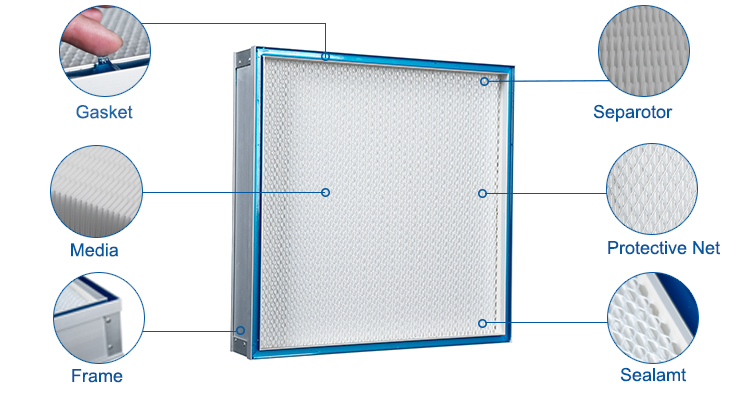
Three rectangles hide inside every size: the name, the actual frame, and the housing opening.
The nominal size is the product’s name. The string 610×610×90 tells you the family, the way A4 names a paper format without being a caliper reading. The actual size is what the finished frame measures: the external width, высота, and depth the supplier builds and holds within a stated tolerance. This is the number your hands can verify at receipt. The housing opening is the third number, and the one people forget. It is the mouth, flange recess, or grid channel the filter must enter and seal against. That opening belongs to your terminal box, AHU, or ceiling grid rather than to any datasheet.
Fit fails when any two of the three are confused. A frame at the top of its tolerance band meets an opening cut at the bottom of the same band, and the unit binds or floats. Replacement HEPA filter sizing records all three names: what you ordered, what arrived, and what the housing accepts. When the three appear on one confirmation sheet with units attached, “roughly the same size” stops being a purchasing decision. It becomes a measurement.
The confusion persists for a searchable reason. The standards that govern HEPA filtration regulate efficiency, тестирование, and classification — EN 1822 in Europe, the Iso 29463 series internationally. None of them regulates what width a 610 filter must be. Size authority sits with the product datasheet and the housing drawing. Buyers who search the standard for a dimension table will not find one.
Common HEPA Filter Dimensions Are Product-Specific
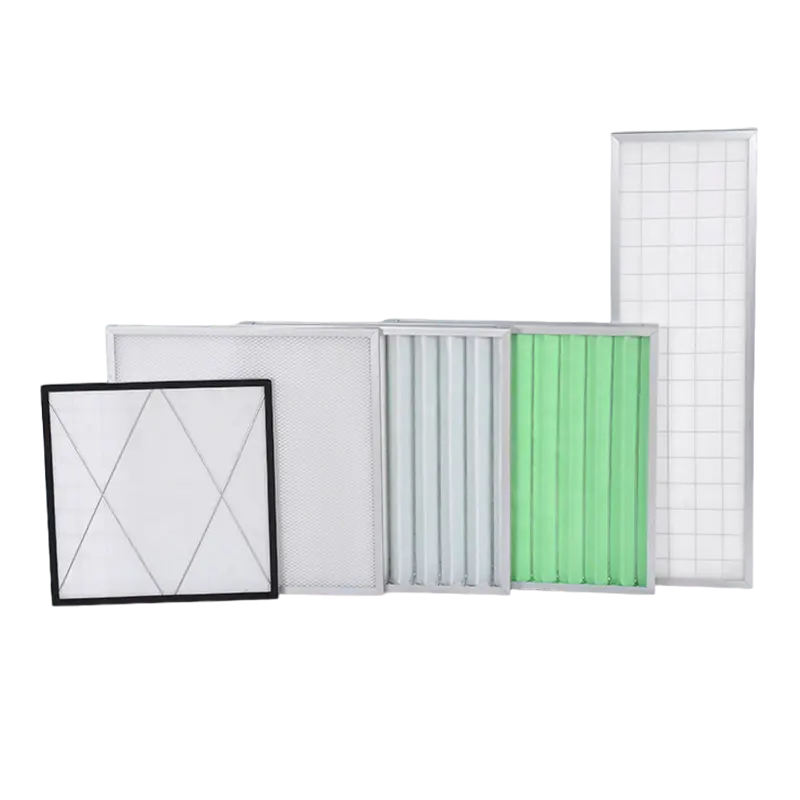
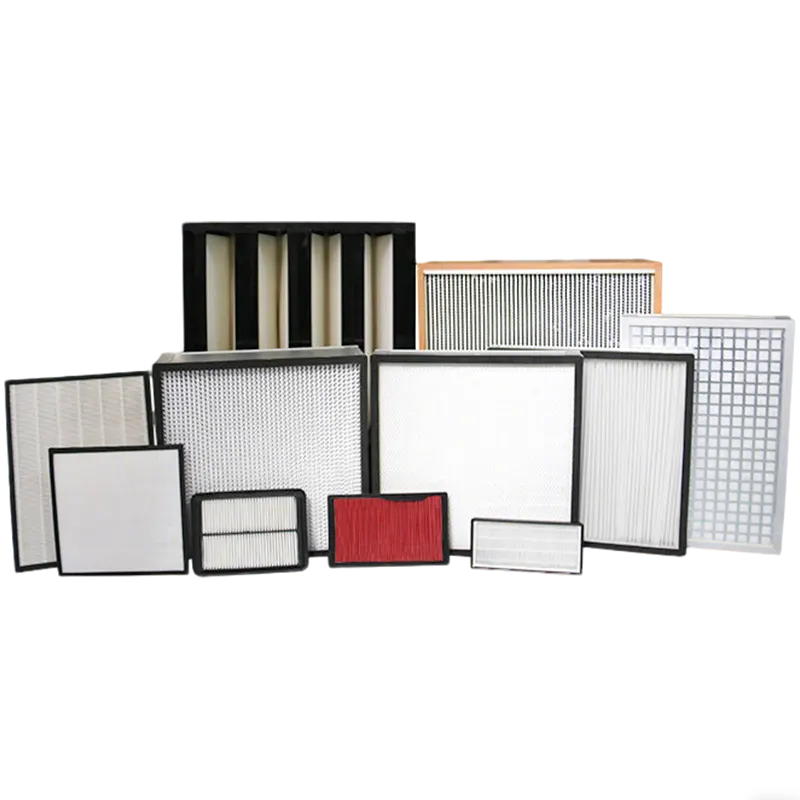
There is no single standard HEPA size. There are standard sizes per product line and per machine.
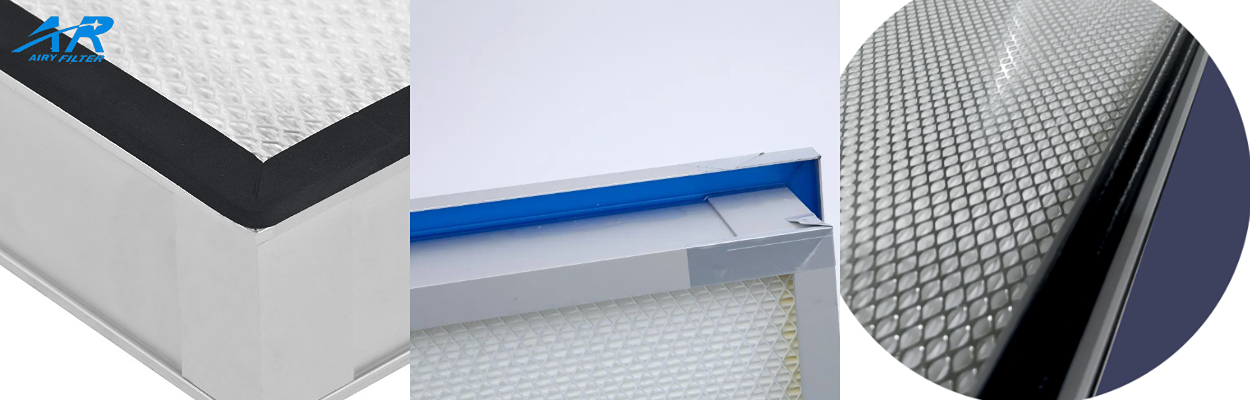
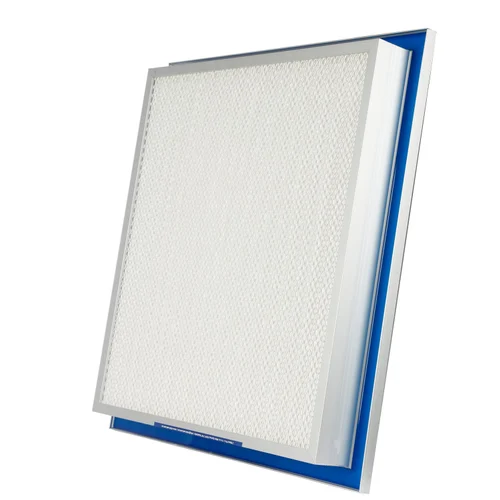
One manufacturer’s own sheets prove the point. Эйри gel-seal mini-pleated line is built around the familiar 610×610 format, with 90 и 93 mm cases. The datasheet row for the 610×610×90 model carries its airflow and resistance at exactly that footprint. The same factory’s V-bank line lists 287×592×292 and 592×592×292 alongside 305×610×292 and 610×610×292. Metric 592-series and 610-series naming coexist across product families. Across these lines, published depths run from 50 mm panels to 292 mm V-bank cases. Each pairing is a distinct filter with a distinct datasheet, not one standard HEPA size in different costumes.
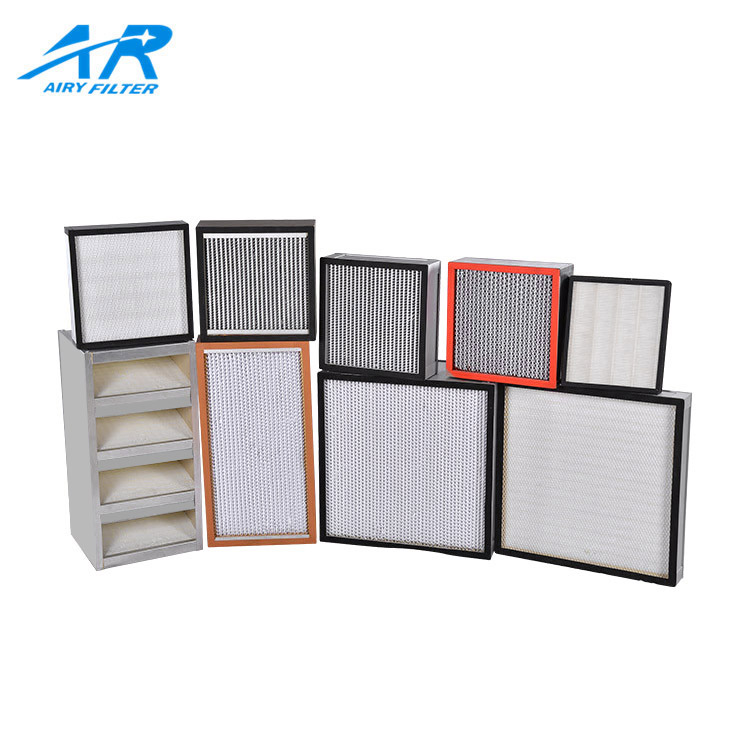
That reality feeds three everyday mistakes. The first is assuming a 610 grid takes a 610 from any supplier. In European AHU practice, 592-class filters share housings with their own gasket and flange conventions. The second is assuming depth is interchangeable. The same 610×610 face at 90 mm is a terminal HEPA, while the 610×610×292 V-bank row carries 27 m² of media. Its smallest sibling lists 8.4 м², and the pressure-drop behavior differs completely between them. The third is assuming global uniformity. Different markets and OEM machines grew their own dimension sets, and any supplier who says one size is standard everywhere is guessing.
How to Measure an Existing Filter for Replacement
Measure the unit and the housing. Five fields, one tape, and a camera get you a replaceable part.
Work the sequence the way a receiving inspector will later check it.
- External width and height: measure across the outside of the frame, at the sealing surfaces. Write the unit down next to every number.
- Глубина: measure along the airflow axis. For pleated or V-bank units, measure the frame depth, not how far a bulged media pack happens to sit.
- Interface: photograph the gasket or gel knife-edge and its position. Record clamps, flanges, and any pull-tab or handle hardware the grid needs.
- Housing opening: measure the mouth the filter enters, at several points. Openings are frequently out of square, which a single measurement hides.
- Identity: copy the label or stamping. Model code, сорт, номинальный воздушный поток, and serial anchor everything above.
Old units deserve a special caution: a spent HEPA frame deforms. Cardboard and even metal frames sag, gel channels collect sealant residue, and gaskets compress permanently. A heavily used filter measured straight out of a grid can read several millimeters away from its true drawing size. When a deformed old part and the nameplate disagree, the nameplate, the original datasheet, or the housing opening are the arbiters. The warped frame is not. For paint-booth and OEM replacement work, наш sizing guide for OEM orders walks the same measure-versus-nameplate logic at the equipment end.
Check Fit and Airflow Before Approving a Different Size
A same face is not a same filter. A substitution review re-checks four fields.
When a supplier offers an alternative size that fits the same opening, run it as an engineering check rather than a favor. Первый, tolerance and sealing: a frame one or two millimeters off at the gasket line can still seal. The same error at a gel knife-edge means the edge misses its channel, and the unit bypasses through the housing. Второй, глубина: the dimension nobody measures is the one that changes the product. Extra depth usually buys media area, which drops face velocity and pressure drop. The class was tested at a construction, not at a footprint, so efficiency behavior moves too.
Третий, the rated pair: the substitute’s airflow and resistance must be stated at your duty point. Наш H14 specification guide lists the fields that make any HEPA comparison honest. Fourth, the airpath: check gasket compression clearance, clamping hardware, and the airflow-direction marking where the housing assumes one.
One rule protects both sides. Any change from the approved nominal size, the approved depth, or the confirmed interface is a re-approval, not a restock. The person who approves a “close” size without re-checking the pair is buying a different filter and hoping it behaves like the first one.
The airflow side deserves its own line on that sheet because it is a system effect, not a product footnote. A fan driving a fixed housing delivers whatever airflow the resistance curve allows. Raise the filter’s pressure drop at the duty point, and airflow falls by whatever the system curve dictates. On constant-volume cleanrooms and paint booths, that sag shows up first as falling face velocity or drift in pressure balances, long before anyone checks a datasheet. The substitution check closes with a fan question. At the substitute’s resistance, does the system still deliver the air the process needs?
Prepare a Custom Dimension Drawing for Supplier Approval
Custom sizes are risky when the drawing is a photo with a phone number, not a sheet of fields.
Airy’s product sheets note plainly that other specifications can be customized according to requirements. The real question is rarely whether a supplier can build it. It is whether the specification is unambiguous enough that the first build is the right build. The sheet below lists the fields you complete on your side and have the supplier counter-sign before production.
| Drawing field | What to state | What it prevents |
|---|---|---|
| Unit of measure | One unit per drawing; conversions shown, not implied | А 610 received as millimeters when the grid was cut in inches |
| Views | Face view, side view, and a section at the sealing interface | Depth and gasket geometry guessed from one photo |
| Critical dimensions | Ширина, высота, and depth marked critical, plus housing-contact details | Cosmetic dimensions argued while sealing ones go unconfirmed |
| Tolerances | Numeric band on each critical dimension, and who verifies it | Each side assuming that standard tolerance means its own number |
| Sealing face | Gasket type and position, or the gel knife-edge outline | A sealed class claim undone by an unsealed interface |
| Направление воздушного потока | Arrow convention on the drawing and on the physical label | A correct filter installed backward at the grid |
| Version and date | Revision number and date, cited on every reorder | Reorders built from a superseded sketch emailed months earlier |
The exchange then runs in three moves. You send the completed sheet with photos of the old unit and the housing mouth. The supplier returns it annotated with the actual build values and the tolerances held — a counter-signature, not a catalog cut. You approve one revision. That revision number goes onto the purchase order, the label requirement, and the goods-receipt check, where a caliper verifies the critical dimensions before the crate is accepted. Reorders cite the same revision, which is how a custom size stays standard two years later.
Воздушная HEPA Filter Solutions
Airy provides customized HEPA filtration solutions to help cleanroom and industrial facilities control fit, поддерживать стабильный поток воздуха, and improve acceptance in demanding environments.
Published Lines and Their Footprints
Several HEPA filter sizes are published across the catalog, each row fixed to its own construction.
- Gel-Seal Mini-Pleated Units: built around the 610×610 format with 90 и 93 mm cases. Each row states its rated airflow pair.
- Mini-Pleat Framed Panels: listed in 50, 70, и 90 mm depths. The same footprint can carry a different rated range than the gel-seal case.
- V-Bank Cells: 592-series and 610-series cases at 292 мм глубина, with media listed from 8.4 к 27 м². The 610×610×292 row lists 27 м².
More formats sit in the HEPA and cleanroom filters catalog, including deep-pleat and high-temperature lines.
Custom Formats and Confirmed Drawings
Where a published row does not match the housing, the drawing path applies. Formats are negotiated against drawings, with the tolerance band stated in writing for every critical dimension. Sample approval fixes the revision every later reorder must match.
OEM-поддержка фильтрации для промышленных партнеров
Beyond catalog units, Airy provides OEM and customized filtration support for distributors and equipment builders. The team has produced custom air filter media since 2009. Support covers material selection, construction design, выборочное тестирование, and documentation for specific housing requirements.
Часто задаваемые вопросы
Five size questions that decide whether the replacement lands.
Are HEPA filter sizes standardized worldwide?
Нет. Efficiency classifications have standards, but physical sizes do not. Markets and OEM machines developed their own dimension sets. One factory’s catalog routinely mixes 610-series and 592-series families. The datasheet row for the specific series, issued for your order, is the authority.
What is the difference between nominal and actual size?
Nominal is the name, the 610 inside the string 610×610×90. Actual is what the finished frame measures within its tolerance band. Both must be checked against the housing opening. Fit is decided by all three numbers, not by matching names on paper.
If the face size matches, can I swap directly?
Not safely. Глубина, sealing interface, tolerance position, and the airflow/resistance rating at your duty point can all differ behind identical face numbers. Any change in those fields is a re-approval decision with engineering sign-off, not a restock. Run the four-field check before accepting the substitute.
Can a HEPA filter be cut down to fit?
Нет. Cutting the frame breaks the media-to-seal boundary on which the classification depends. A trimmed gasket edge also stops matching the compression surface it was originally tested against. A field-cut unit becomes an unclassified unit. Change the housing, or order the confirmed size from the supplier.
What data does a custom size order need?
A drawing sheet carries the order. State the unit of measure, three views including a seal detail, and every critical dimension with its numeric tolerance. Add the sealing-face geometry, the airflow-direction arrow, and a revision number. The supplier counter-signs that revision before production starts.