Salta al contenuto

Every paint booth does two filtration jobs at once: it cleans the air coming in, and it catches the paint going out. Ceiling filter media handles the first job. The second is where paint pocket filters earn their keep, and it is also where a lot of buyers overspend, because they compare pads on price per piece instead of cost per booth change.
This guide covers what paint pocket filters are, why the pocket geometry changes loading behaviour, what G2, G3 and G4 actually mean, which of the 20×20 and 20×25 sizes fit which booth, and how to read a test report so that a specification cannot be quietly downgraded.
What Are Paint Pocket Filters?
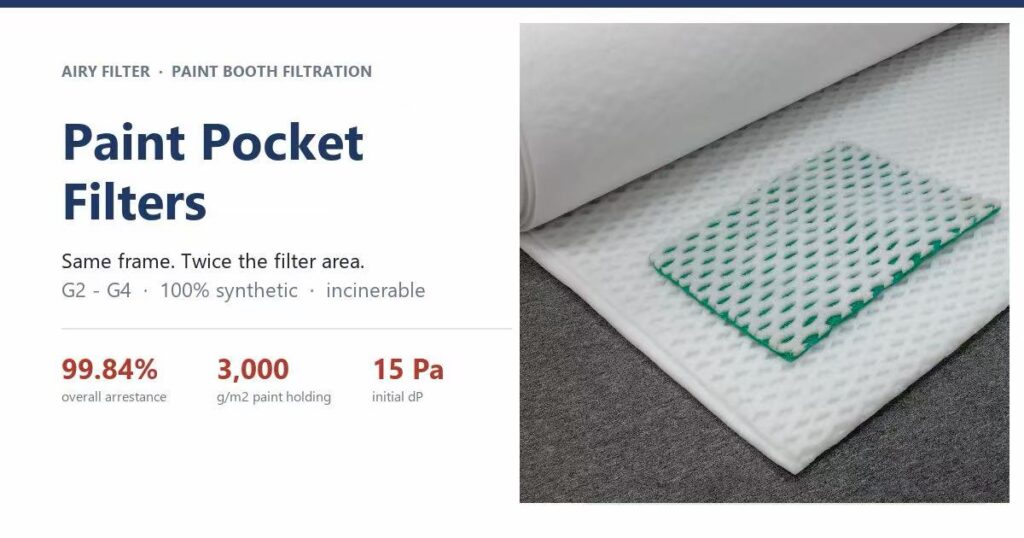
A paint pocket filter is a paint arrestor built from high-loft non-woven polyester and formed into a three-dimensional diamond pocket structure instead of a flat pad or a uniform-thickness blanket. The media is moulded into shallow pockets that stand proud of the frame, and air passes through the pocket walls and floors rather than a single flat face.


In the trade the same product is called paint pockets, filtri a tasche per cabine di verniciatura, paint pocket filter media, or paint pocket exhaust filters. All of them describe the same item at different points in the buying chain: paint pockets is what the end user says, paint pocket filter media is what a converter or an importer says.
One naming note that matters when comparing quotes. For buyers comparing industrial filtration solutions, Filtro arioso provides a broader range of air filtration products and customized solutions for different applications.Paint Pockets® is a US brand name that has become shorthand for the whole category, the way people say Hoover for a vacuum. A supplier offering paint pockets is not necessarily offering that brand, and a brand-name pad is not necessarily the right specification for your booth. Ask for grade, basis weight and cut size, not just the noun.

It is also worth separating this product from a similarly named one. Pocket filters in HVAC are bag filters with sewn fabric pockets, rated F7 to F9 and used for fine particulate. A paint booth pocket filter is a coarse overspray arrestor rated G2 to G4. They share a word and nothing else, and mixing them up is one of the most common specification errors we see in incoming enquiries.


Why the Diamond Pocket Works
Three things happen when you replace a flat pad with a pocketed one, and all three extend service life.
- More effective area in the same opening. On our own 400 g/m² sample, the diamond structure doubles the effective filter area within a given frame size. Twice the area at the same airflow means half the face velocity.
- Lower face velocity captures rather than drives. Overspray is sticky and heavy. At high face velocity, droplets are pushed into and through the media; at lower velocity they land and stay. This is the single biggest reason pocket media outlasts flat media of the same grade.
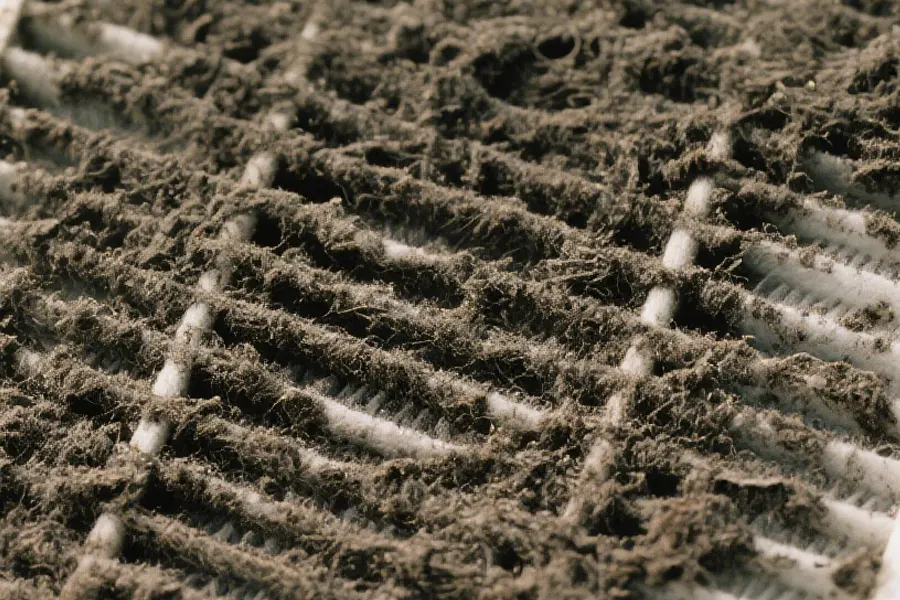
- Loading is distributed, not concentrated. A flat pad blinds in the centre first, where velocity is highest, and the whole pad is scrapped while the edges are still clean. The diamond pockets load progressively across walls and floors, so you use the media you paid for.
The structure also solves a mechanical problem. A built-in grid backing layer holds the pockets open under load, so the pad does not collapse into the frame when it becomes heavy with paint. That rigidity is what allows the media to keep working past the point where a glass-fibre blanket has already matted down.


Specifiche: What the Test Data Shows
These are the figures from our own submitted sample, tested to ASHRAE 52.2-2017 and reported on 27 July 2026. They are the numbers to compare against any other supplier’s sheet, line by line.
| Property | Valore | What it means in practice |
|---|---|---|
| Media | 100% high-loft multi-ply non-woven polyester | No glass fibre, no shedding, fully incinerable |
| Struttura | 3D diamond pocket with built-in grid backing | Doubles effective area, resists collapse under load |
| Basis weight | 400 g/m² | Reference SKU; other weights available |
| Spessore | 30 mm | Nominal; confirm cut thickness for your frame |
| Initial pressure drop | 15 ± 2 Altro e 0.6 SM | Low enough for retrofit into existing booths |
| Final pressure drop | 200 PA (datasheet) / 250 Pa max tested | Your change-out trigger point |
| Max tested air velocity | 3.5 SM (700 FPM) | Headroom above normal booth face velocity |
| Paint holding capacity | 3,000 g/m² rated; fino a 6,000 g/m² in test | The number that decides changes per year |
| Capacità di trattenimento della polvere | 800 g/m² | Dry particulate, before paint loading |
| Overall arrestance | 99.84% | Gravimetric arrestance of the sample |
| Flammability | UL Class II flame rating | Confirm certificate wording for your AHJ |
| Continuous temperature | 100 °C | Standard booth conditions; confirm for bake cycles |
Fractional efficiency is worth reading closely, because it tells you what the product is for. On the same sample:
| Particle size | Fractional efficiency |
|---|---|
| 20 micron | 100.0% |
| 10 micron | 99.8% |
| 5 micron | 84.5% |
| 2.5 micron | 4.2% |

That last line is the honest one. A 2.5 microns the efficiency collapses to 4.2 per cento, because this is a coarse arrestor designed to catch liquid overspray, not a fine particulate filter. A supplier who quotes 99 percent efficiency without showing the particle size curve is telling you half a story. If your process needs fine particulate control downstream, that is a different stage and a different product.
Grades: What G2, G3 and G4 Mean
Pocket media is normally offered in three coarse grades. The grade describes arrestance, not service life. Service life is a function of media area, airflow and paint solids, which is why the same G3 pad can last six weeks in one booth and six months in another.
| Grado | Classificazione | MERV equivalent | Typical position | Best for |
|---|---|---|---|---|
| G2 | IN 779 coarse / Iso 16890 Coarse band | Merv 5-6 | Light overspray, low solids | Waterborne, low film build, touch-up bays |
| G3 | IN 779 coarse / Iso 16890 Coarse band | Merv 6-7 | General purpose, mid solids | Solvent-borne refinish, the default choice |
| G4 | IN 779 coarse / Iso 16890 Coarse band | Merv 7-8 | High solids, heavy build | Clearcoat lines, high film build, heavy colour |
Two cautions on grade tables. Primo, the MERV column is an approximate cross-reference, not an equivalence, because EN 779 e ASHRAE 52.2 test different things and ISO 16890 replaced EN 779 as the European standard. Secondo, G4 is not automatically better than G3. A higher grade buys finer capture and costs pressure drop, and on a booth that already runs a paint stop as a first stage, the incremental gain is often small.
Which Applications the Media Is Built For
The pocket structure is specified for the difficult end of paint filtration: high-solids coatings, powder paint, water-based paint, multi-component paint, colourants and adhesives. Those are the materials that generate sticky slag rather than dry dust, and slag is what blinds a flat pad in days.
It is used as sheet media in the exhaust stage of a spray booth, and can be cut to size for a filter frame or supplied as roll media for a converter. Where a booth runs a glass-fibre paint stop on the floor as a first stage, the pocket pad normally sits behind it as the second stage and carries the fine fraction the stop misses.
Verde, White and the Colour Question
Buyers frequently search for green paint pocket filters or paint pockets white, expecting the colour to identify the grade. It does not. Colour is a supplier convention tied to grade and basis weight, and it varies between manufacturers and regions. Green is the common general-purpose colour in North American distribution; white usually marks a heavier or finer grade, but you will find suppliers who reverse this.
The safe approach is to specify grade, basis weight in grams per square metre, thickness and cut size, then use colour only as a secondary check against a retained sample. If a buyer insists on matching a colour because their maintenance team is trained to it, get a signed sample approved before the production run, not after.


Dimensioni, Rolls and Hardware
Pads are sold in nominal inch sizes, most commonly 20×20 and 20×25, with 24×24 appearing in exhaust pad formats. Nominal is the operative word: 20×20 is usually about 508 × 508 mm and 20×25 Di 508 × 635 mm, but actual cut size varies by a few millimetres between suppliers, and a few millimetres is enough to stop a pad seating in its frame. Always confirm actual cut size and tolerance in writing.
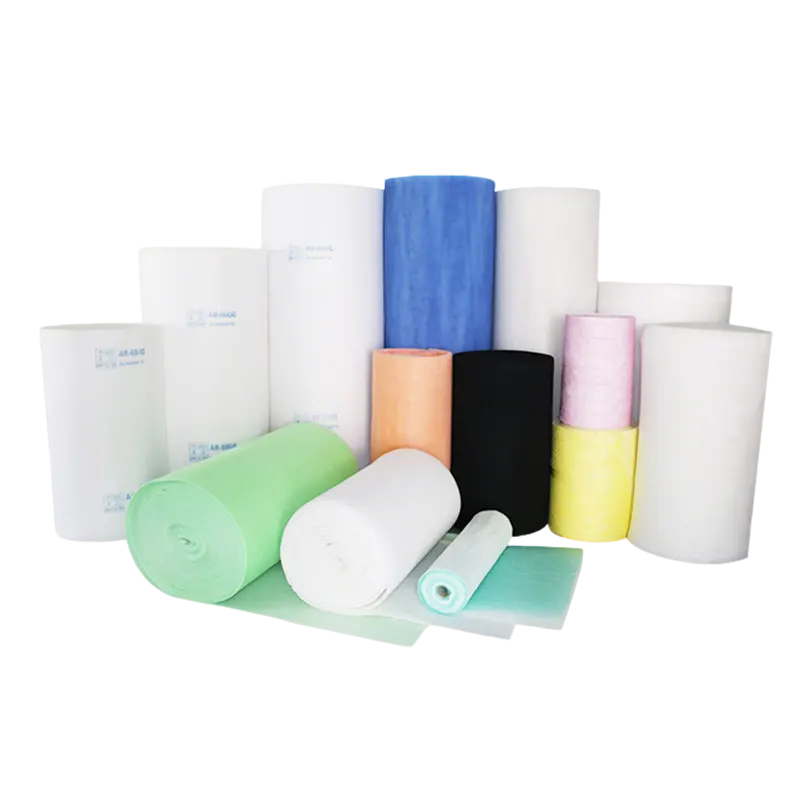
Paint pocket filter roll is the format most distributors and converters buy. Three parameters decide whether a roll is usable: larghezza, roll length, and the orientation of the pocket pattern. If the pockets run across the roll rather than along it, cutting to a 500 mm width slices through the pocket geometry and you end up with expensive flat media. Confirm pattern direction before you commit to a container.
Hardware is where cheap projects fail late. Holding frames, support grids and zipper systems determine whether a filter change takes three minutes or twenty, and they are usually bought once and forgotten. If you are specifying a new booth or re-fitting an old one, price the frame with the media.
Where Pocket Filters Sit in a Booth
Pocket media is an exhaust-side product. It goes in the exhaust plenum, downstream of the coarse paint stop and upstream of the fan. In a cross-draft booth that means the exhaust wall; in a downdraft booth, the floor grating or the plenum below it; in a side-downdraft booth, the side plenum.
It does not go in the ceiling. Intake air is cleaned by media filtranti a soffitto, typically M5 synthetic media with a flame-retardant backing, and the two products are not interchangeable. Substituting one for the other is the fastest way to ruin a finish, because intake filtration protects the wet paint surface while exhaust filtration protects the plant.


Paint Pockets vs Paint Stop vs Arrestor Pads vs Ceiling Media
Four products, four jobs. Most enquiries that arrive with the wrong product name can be resolved with this table.
| Prodotto | Posizione | Media | Grado | Job |
|---|---|---|---|---|
| Paint pocket filters | Exhaust plenum | 100% sintetico, 3D diamond pocket | G2-G4 | High-capacity overspray capture, protects the fan |
| Paint stop / floor filter | Exhaust floor | Fibra di vetro, graduated density | G3 | Bulk paint mist, low cost, solvent and high temperature |
| Paint arrestor pads | Scarico, Piatto | Fiberglass or paper, Piatto | G3 | Low-cost first stage or baffle |
| Media filtranti a soffitto | Intake ceiling | Sintetico, tackified | M5 | Particle removal from incoming air |
Many booths run two exhaust stages: arresto della vernice as the bulk catcher on the floor, pocket media behind it as the polish stage. That arrangement is usually cheaper over a year than running pocket media alone, because the stop takes the heavy loading and the pocket keeps its area for the fine fraction.


How to Specify a Pocket Filter Order
Nine lines in a purchase enquiry will save a week of email and one wrong shipment.
- Booth type and airflow, in CFM or cubic metres per hour.
- Frame opening size plus the actual cut size you need, con tolleranza.
- Grado, and the test method behind it.
- Basis weight in g/m² and thickness in mm.
- Pocket pattern and depth, or a photo of the existing pad.
- Media colour and binder, only if matching an installed product.
- Flame retardancy requirement, if your authority having jurisdiction asks for it. Confirm the certificate rather than assuming it.
- Quantity per change and changes per year, so the supplier can quote annual usage.
- Packing: pads per carton, rolls per pallet, and whether you need mixed loading.
Cost per Change, Not Price per Pad
At a rated paint holding capacity of 3,000 g/m², a 20×20 pad holds roughly 1.2 kg of overspray before it reaches its final pressure drop. That is the number that sets your change interval, and it is the number a cheap flat pad cannot match, because most of its thickness is never used.
Run the arithmetic per position rather than per piece. A pad at 2.10 USD changed eight times a year costs 16.80 USD. A pad at 3.20 USD changed four times costs 12.80 USD, and it saves four change-outs of labour, four interruptions to the booth schedule, and the disposal cost of four sets of media.
Then add the failure case. A pad that blinds early raises pressure drop, reduces airflow, and eventually pulls overspray past the arrestor into the fan and ductwork. Cleaning a fan costs more than a year of filters. This is why the honest comparison is cost per booth per year, not price per pad.
On replacement interval, three to six months is the usual industry guidance for booth filtration generally, with pocket media typically at the longer end in a well-staged booth. The real trigger is pressure drop, not the calendar. A differential gauge across the exhaust stage costs very little and turns filter buying from guesswork into a schedule.
For Distributors and Booth OEMs
Buyers in this segment care about four things beyond price
- Batch-to-batch consistency of cut size and pocket depth, because a distributor who receives a pallet that does not fit the frame returns the whole container.
- Private label and carton printing, usually from a few hundred cartons.
- Mixed containers, so pocket media ships alongside paint stop and ceiling media instead of waiting for a full container of one SKU.
- Lead time stability. A distributor will pay a few percent more for a supplier who ships in the same week every quarter.
Domande frequenti
Are paint pocket filters the same as paint arrestor pads?
NO. Arrestor pads are flat, usually fiberglass or paper, and are used as a low-cost first stage. Pocket filters are three-dimensional synthetic media with roughly twice the effective area for the same frame opening, and they are used where loading capacity matters. Some catalogs list pocket media under arrestor pads because it performs the same function, which is where the confusion starts.
Is paint pockets a brand or a product?
Entrambi. It began as a brand and is now used generically for any pocketed overspray arrestor. When a buyer asks for paint pockets, confirm whether they need to match an installed brand or simply need the category, because the two lead to different specifications and different prices.
How much paint does a pocket filter actually hold?
On our 400 g/m², 30 mm sample, the rated paint holding capacity is 3,000 g/m², and the same sample held up to 6,000 g/m² before reaching its maximum pressure drop in testing. For a 20×20 pad that works out to roughly 1.2 kg at the rated figure. Compare any competing sheet against those two numbers and against the particle size curve behind them.
Which grade should an automotive refinish booth use?
G3 is the usual default for solvent-borne refinish. Move to G4 for high-solids clearcoat and heavy film build, and down to G2 for waterborne or low-solids work where the loading is light. If the booth already runs a paint stop as a first stage, G3 behind it is normally sufficient.
Can I use pocket filters in the ceiling?
NO. The ceiling takes ceiling filter media, typically M5, which is a different product with different efficiency and a tackified surface. Pocket media in the ceiling will not give you the intake cleanliness a finish needs.
Do you supply paint pocket filter rolls as well as pads?
SÌ. Rolls are quoted by width, roll length and pocket pattern orientation, and we confirm pattern direction against your cutting plan before production. Send the frame size and the number of pieces per roll you want to cut, and we will come back with a cutting layout rather than a price list.
Getting the Specification Right the First Time
Pocket media is a simple product with three variables that decide whether it works: grado, effective area and cut size. Get those three onto one page with the booth airflow, and the quote comparison becomes arithmetic instead of negotiation.
If you send us the frame opening, the current pad or roll you are using, and the number of changes per year, we will return a specification sheet with grade options, effective area, and a cost-per-change comparison for one booth, together with the full test report behind the figures on this page. A Filtro arioso, we support paint booth operators, distributori, and OEM buyers with customized filtration products and application-specific solutions.