A V-bank HEPA filter is a shape decision before it is a performance decision. Mini-pleat media packs sit in angled V rows inside a deep frame, so one 610×610 face carries the media area of a much larger flat panel. That geometry is why V-banks earn their place in air handling units with tight footprints and big volumes. It is also why two units that are both 610 V-bank can range from F8 to H13, with 112 Pa between them at the same rated airflow. Choosing one means matching the structure to your housing and the grade to your air, field by field.
This guide separates the structural name from the efficiency claim. It shows when the V layout is worth its depth. It compares the format against flat-panel HEPA under equal conditions, and it closes with the eight-field specification sheet a V-bank order needs.
Key Takeaways
- Geometry names the shape, the class names performance: the same V-frame line is sold at F8, H10, and H13. The structure proves nothing about the class.
- Depth buys area, area buys lower resistance per airflow: that chain is the whole reason to consider the shape. It needs about 292 mm of housing to pay.
- Compare only at equal grade and equal airflow: V-bank versus flat-panel is a datasheet-pair review, not a shape preference.
What Makes a V-Bank Filter a HEPA Filter?
Nothing in the V shape makes a filter HEPA. Only a tested class does.
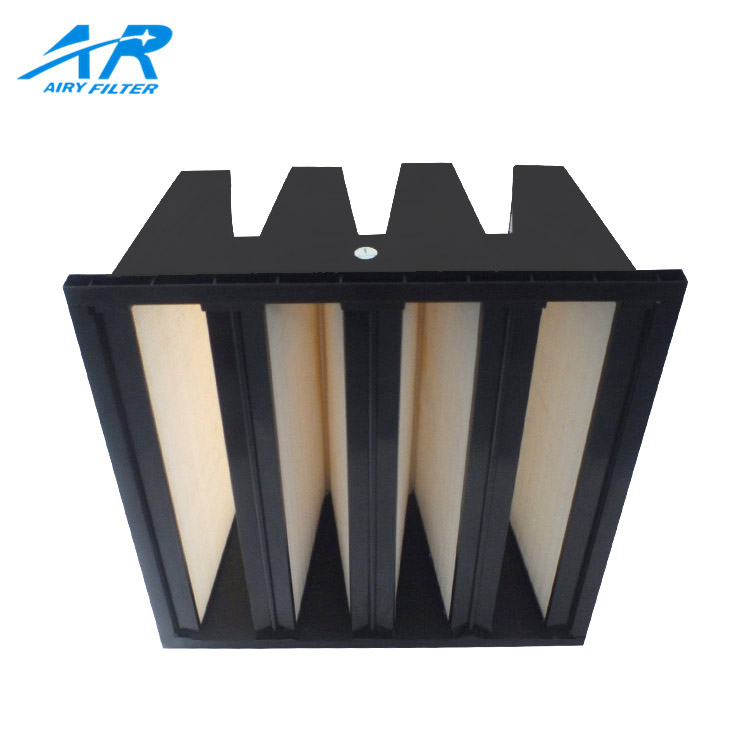
The name V-bank, also sold as V-cell, describes how the media is arranged. Several rigid mini-pleat packs sit at angles to form V channels, held in a frame with a flanged or box-style mounting edge. On Airy’s AR-HV line, the 610×610×292 mm unit packs 27 m² of filter area behind one standard face. The smaller 287×592×292 row carries 8.4 m².
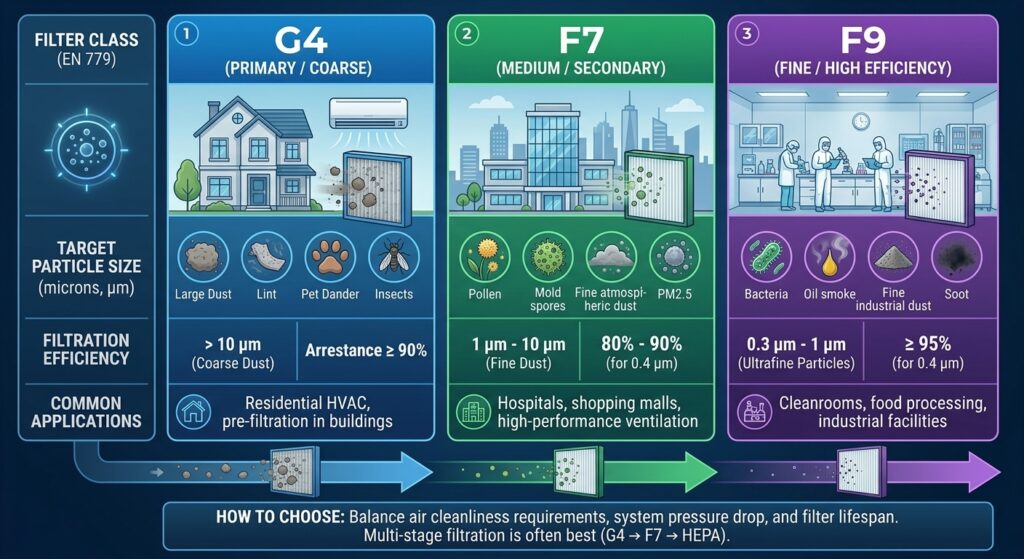
The same product table sells that identical frame at F8, H10, or H13 classes. The V geometry is shared from a coarse prefilt up to a true HEPA unit. Class names belong to the test standards, ISO 29463 and EN 1822, not to the shape. So when a datasheet is titled V-Bank HEPA Filter, the grade claim needs the usual evidence trail. That trail is the class with its standard named, the finished-unit efficiency at the stated airflow, and the per-unit leak records your acceptance file requires. These are the checks any H14 specification sheet demands, with our testing guide covering how the reports are produced. The structure is a packaging choice; HEPA is a measurement result. Keep them on separate lines of your sheet.
When Is a V-Bank Design Worth Considering?
The V-bank earns its keep where face area is fixed, volume is high, and depth is available.
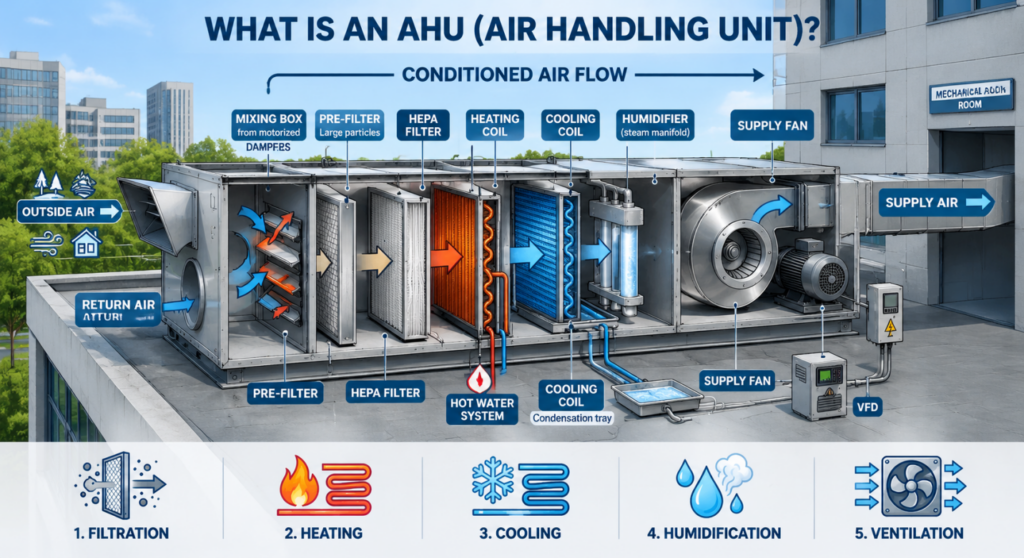
Three conditions decide it. First, airflow against a fixed face: a V-bank’s value is media area per square meter of housing opening. Our 610×610×292 line item is rated at 2,700 m³/h with initial resistance of 68 to 180 Pa depending on grade. At 3,600 m³/h the same row shows 90 to 240 Pa. Those volumes exceed what a shallow panel behind the same face can match at comparable resistance. A high-volume AHU section in a standard footprint is the V-bank’s home ground.
Second, available depth: the geometry needs roughly 292 mm of room, plus handling clearance for withdrawal. A terminal box built for 90 mm mini-pleats will not accept it, and forcing it means redesigning the housing. At that point the drop-in savings disappear. Third, operating and maintenance conditions: the deep, open V channels suit dust-loaded AHU duty, where high dust-holding capacity and full-face access during change-out matter. They are also bulkier to lift, store, and dispose of than slim panels, which is a real cost on high grids and in tight plant rooms.
Two cases decide often. When you restock a housing that already holds V-banks, record the frame stamping, V-row count, and mounting style before the crew discards the label. For a distributor, one 292 mm SKU family covers airflows that would take several shallow panel sizes, provided the target machines have the depth.
The shape does not automatically buy lower energy, longer life, or a free efficiency upgrade. Those claims need your system’s numbers, not the brochure’s. The next section shows how to read them.
V-Bank vs. Flat-Panel HEPA: Compare Under Equal Conditions
Two honest datasheet rows tell you more than any shape argument.
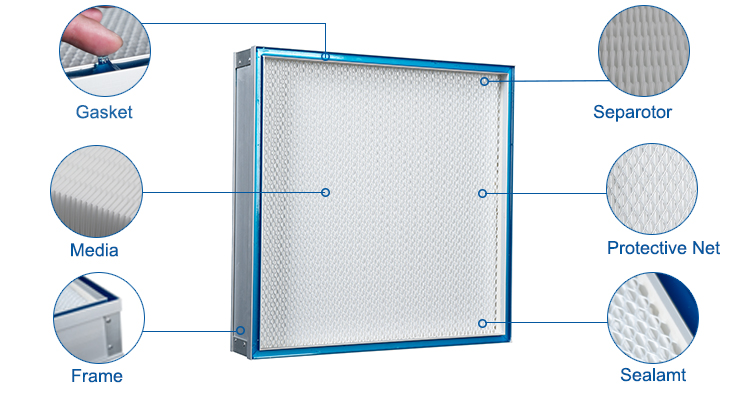
Here is the pattern with both products pulled from the same factory’s own sheets. A gel-seal H14 terminal unit at 610×610×90 carries 14.08 m² of media. Its initial resistance reads below 110 Pa at 650 m³/h and below 220 Pa at 1,300 m³/h. The AR-HV V-bank at 610×610×292 carries 27 m², rated at 2,700 and 3,600 m³/h. Same nominal face, roughly triple the depth, double the media area, and a completely different airflow class. That is exactly why comparing a panel to a V-bank without naming grade and airflow answers nothing.
| Dimension of comparison | Flat-panel / mini-pleat HEPA | V-bank HEPA |
|---|---|---|
| Media area per face | Modest (14.08 m² behind 610×610×90) | Roughly doubled (27 m² behind 610×610×292) |
| Housing depth needed | Shallow, terminal-box friendly | Deep (about 292 mm) plus withdrawal clearance |
| Airflow per standard face | Low to mid, up to about 1,300 m³/h class | High (2,700–3,600 m³/h class on one 610 face) |
| Resistance at rated duty | Reads low at its own airflow; compare at equal airflow | Rises with grade: 68 / 135 / 180 Pa at 2,700 m³/h (F8 / H10 / H13) |
| Dust holding and change-out | Light, quick to swap, more frequent on dusty air | Higher capacity, heavier handling, longer AHU intervals |
| Class range sold in format | Up through H14 and gel-seal HEPA terminals | Coarse to HEPA (F8 / H10 / H13 rows in one table) |
Read the table as a method, not a verdict. On any row, the fair question is what the two units each do at your grade, your airflow, and your depth. Within one V-bank size, initial resistance climbs from 68 to 180 Pa between F8 and H13 at constant airflow. That is the same grade-for-resistance trade the H13 vs H14 guide follows through to the system. In datasheet comparisons, shape does not win fights. Airflow and media area do.
Check Housing Fit, Sealing, and Rated Performance
A V-bank is heavier, deeper, and more flange-specific than the panel it replaces.
Before any V-bank order, walk the housing with four checks. Fit: the frame width, height, and depth against the opening and the access door. The unit must leave as straight as it entered, so withdrawal clearance is part of fitting. Support: 292 mm deep packs at 610×610 are substantially heavier than slim panels, wet or dry. The rails, clamps, and seal surface must carry them without flexing the flange. Interface: the AR-HV line is built in two mounting styles, a flanged type and a box type. Your AHU accepts one of them, and guessing here is the most common field failure with this format. Sealing and direction: confirm the gasket or flange seating, the clamp compression, and the airflow arrow before the door closes.

Finally, the rated-performance pair: every candidate row must show resistance at your airflow and your grade, as the factory table’s own cells pair Pa with m³/h. A supplier who quotes the same size without re-stating the pair is describing the box, not the product. Face dimensions alone do not decide compatibility; depth, interface, support, and the rated pair do. Our pleated panel specification guide lists the fields the AHU world uses for shallow formats, and the V-bank sheet needs the same discipline at 292 mm.
Build a V-Bank HEPA Purchase Specification
Eight fields separate a V-bank order from a V-bank lottery ticket.
Use the sheet below on both sides of the handshake. Items marked engineer review are where the buyer’s own documents, not the supplier’s catalog, must supply the answer.
| Field | What to state | Who confirms |
|---|---|---|
| Efficiency class and standard | F8, H10, or H13, cited against EN 1822 or ISO 29463 by name | Buyer states; supplier’s datasheet row confirms |
| Airflow / resistance pair | Duty m³/h, max initial ΔP, and replacement ΔP limit | Engineer review; the fan curve decides both |
| Face, depth, tolerance | W×H×D in one unit, numeric tolerance, withdrawal clearance | Buyer measures housing; supplier confirms built size |
| Mounting style | Flanged or box type; V-row count (4V / 5V) at the interface | Engineer review; one style per AHU section |
| Frame and build | Plastic or aluminum frame option, humid or outdoor exposure call | Supplier confirms build; buyer confirms environment |
| Weight and support | Unit weight band, rails and clamps available in the housing | Engineer review |
| Reports | Which per-unit test documents ship, named by type | Buyer states; supplier confirms format sample |
| Customization path | Non-standard sizes on a versioned drawing, counter-signed before production | Both parties; the drawing carries the fields |
Before the shop floor starts cutting, turn the filled sheet into three exchanged documents. Ask for the spec back counter-signed, so every class, airflow, depth, and interface line is one the supplier has accepted in writing. Request a blank sample of the per-unit test report so the field names match your acceptance file. Take the unit weight and handling data early. These three artifacts move the order from a shared assumption to a signed specification.
Airy V-Bank HEPA Filter Solutions
Airy provides customized HEPA filtration solutions to help industrial AHU facilities control media area, maintain stable airflow, and improve acceptance in demanding environments.
The AR-HV Row Family
Four published sizes anchor the V-bank HEPA filter line, each fixed to its own mounting style and airflow pair.
- 287×592×292: flanged 4V rows with 8.4 m² of media area. The rated pairs run from 1,200 to 1,600 m³/h.
- 592×592×292: 18.8 m² behind the frame, with airflows from 2,400 to 3,200 m³/h on the published rows.
- 305×610×292: box-type 5V rows with 13.5 m², rated from 1,350 to 1,800 m³/h.
- 610×610×292: the 27 m² flagship, carrying the 2,700 and 3,600 m³/h pairs cited throughout this guide.
Each row is quoted at F8, H10, or H13, and the full size and resistance table sits on our V-bank HEPA filter product page.
Custom Builds and Counter-Signed Drawings
The product pages note that other specifications can be customized according to requirements. Custom formats move onto a versioned drawing with tolerance bands, the mounting-style choice, and the sealing detail fixed in writing. Sample approval makes that revision the standard for later reorders.
OEM Filtration Support for Industrial Partners
Airy provides OEM and customized filtration support for distributors and equipment builders, and has produced custom air filter media since 2009. Support covers material selection, construction design, sample testing, and documentation for specific AHU sections.
Frequently Asked Questions
Five questions buyers ask a V-bank datasheet, and what actually answers them.
Are all V-bank filters HEPA?
No. V-bank is a construction. The same line is commonly sold from F8 through H13. Only a class row with its standard and finished-unit test evidence makes a V-bank HEPA filter claim verifiable at goods-receipt.
Does a V-bank always have lower resistance?
No. Its extra media area lowers resistance per unit of airflow, but resistance still climbs with grade. Within one 610×610×292 size, initial resistance runs from 68 Pa at F8 to 180 Pa at H13 at the same 2,700 m³/h. Compare only at equal airflow.
Can a V-bank replace a flat-panel HEPA directly?
Only after a fit review. The panel housing must accept roughly triple depth plus withdrawal clearance, carry the added weight, and match the flange or box interface. Same face size is not interchangeability. Re-check the airflow and resistance pair at your duty point too.
What should I verify in the AHU before ordering?
Check the opening dimensions, the depth clearance, and the withdrawal path first. Confirm the rail and clamp support for the heavier pack, the sealing interface style, and the airflow-direction convention the frame label must follow on site.
What information does a V-bank inquiry need?
The eight-field sheet above. State the class with its standard, the airflow and resistance pair, and the face-depth-tolerance set. Add mounting style, frame build, weight facts, named report types, and a versioned drawing for non-standard sizes.