Deciding on H14 is the smallest part of ordering an H14 HEPA filter. The class line fixes one commitment: a minimum whole-unit efficiency at the most penetrating particle size. It says nothing about the dimensions, airflow, resistance, seal type, or paperwork that a factory actually builds and ships. What makes an order executable is the rest of the specification sheet, field by field.
This guide walks the fields that decide whether the filter that arrives fits your housing and your acceptance file. It closes with a blank H14 HEPA filter specification sheet you can fill from your side and send to any supplier. The sheet also flags where a datasheet stays silent and a question is still due.
Key Takeaways
- Class is one row, not the sheet: H14 fixes the efficiency commitment only; size, airflow, resistance, and sealing are separate fields you must state.
- Airflow and resistance travel as a pair: a pressure-drop number without its rated airflow is not comparable between products.
- Every claim needs an identifier: model codes and report serials are what connect the datasheet row to the unit in the crate.
What Does H14 Tell You—and What Does It Not?
H14 is an efficiency commitment with a testing basis attached. Everything else on the order is a separate field.
Under EN 1822, a filter classified H14 must reach at least 99.995% efficiency at its most penetrating particle size (MPPS). The MPPS is the worst-case point, found by measuring across a range of particle sizes for that specific construction. The parallel ISO series, ISO 29463, covers the same territory with its own naming. Quote whichever standard your project accepts, by name and part.
What the label does not carry: the outside dimensions or depth, the rated airflow, the initial and final resistance, the frame material, the sealing method, or the report package. Two filters that are both “H14” can differ on every one of those lines. And if H14 is still contestable against H13 for your duty, the H13 vs H14 comparison covers that decision. This article assumes the grade is settled and treats only what you still must specify.
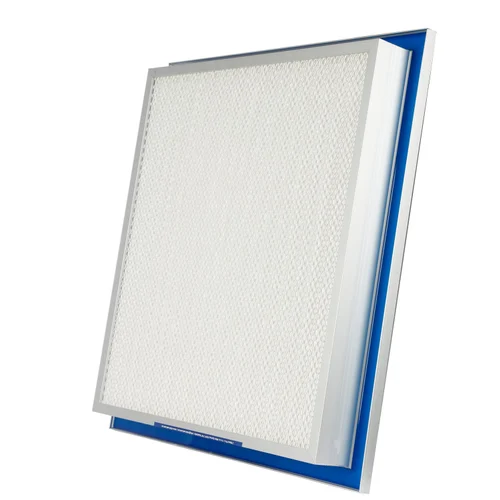
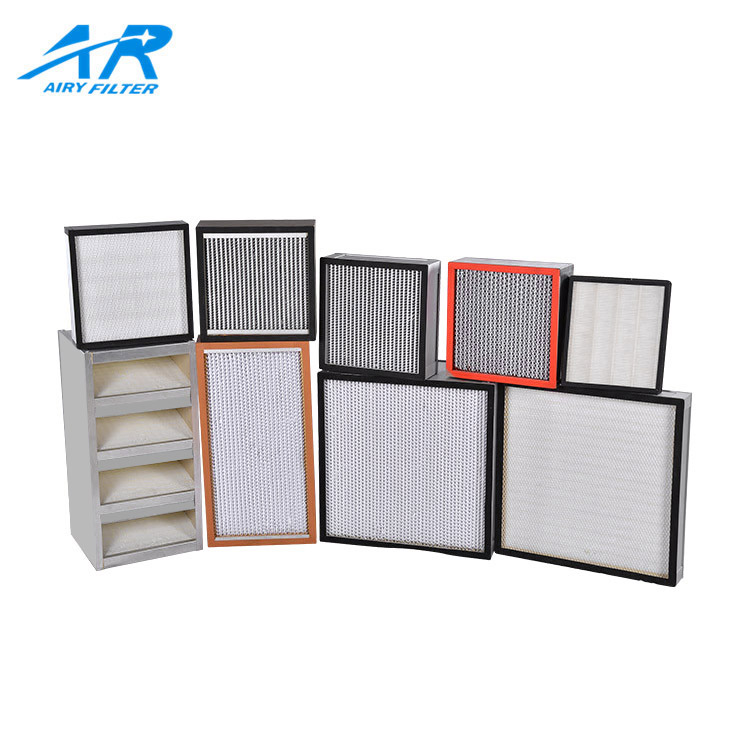
The practical consequence: a request quoting “supply H14 filters, 610×610” invites a supplier to fill in every blank with their own default. The confusion usually starts in the RFQ itself, where “H14” occupies one cell while the engineering fields sit in free-text nobody filled in. The same class label ships in multiple constructions and depths. Airy’s gel-seal line lists 90 mm and 93 mm cases, while its mini-pleat line lists 50, 70 and 90 mm panels. Even the identical 610×610×90 size carries different rated airflow ranges on the two product pages. None of those choices is wrong; they are simply not decided by the grade. The next four sections are those blanks.
Specify Airflow and Pressure Drop as a Matched Pair
Resistance is a function of airflow. State the pair, or accept that nothing on the sheet is comparable.
Every honest HEPA datasheet ties its pressure-drop figures to a stated airflow, and usually to both a clean and a loading-end condition. Airy’s gel-seal H14 model in 610×610×90 mm is a worked example. Its sheet lists two rated operating points: 650 m³/h with initial resistance below 110 Pa, and 1300 m³/h with initial resistance below 220 Pa. The same row carries final-resistance recommendations below 350 Pa and below 500 Pa, on 14.08 m² of media area. Same filter, same class, two different pressure-drop numbers, because the airflow differs.
That is why “Supplier A shows 95 Pa and Supplier B shows 220 Pa, so A is better” fails as a comparison. Unless both figures carry the same airflow, the same units (Pa vs in. w.g. vs mm w.c.), the same clean-versus-used condition, and ideally the same frame depth affecting the free-area ratio, the two numbers describe different duties. When you write the order, the airflow field and the initial-resistance field belong in one row. State it as: rated at ___ m³/h, initial ΔP below ___ Pa at that airflow. If your AHU’s operating point is fixed by the fan curve, say so on the sheet and ask the supplier to confirm resistance at your airflow, not theirs.
One boundary: the initial and final resistance values on a datasheet are that model’s recommended replacement guidance. Your system’s dust load decides the real interval, and no supplier can specify it blind.
Treat the final-resistance field as a system decision made by you, not a product attribute quoted by them. As a HEPA unit loads, resistance climbs and the fan’s airflow sag follows. Your engineer, not the filter vendor, decides which sag the process can tolerate before change-out. Write that number onto the sheet (“replace at ___ Pa; airflow at replacement must stay above ___ m³/h”), then make the supplier confirm their recommended final figure is compatible with it. When the pair on the sheet is your airflow and your limit rather than two datasheet averages, resistance comparisons between offers finally mean something.
Confirm Dimensions, Frame, and Seal Compatibility
The housing decides fit. “H14” never does, and it never decides the sealing method either.
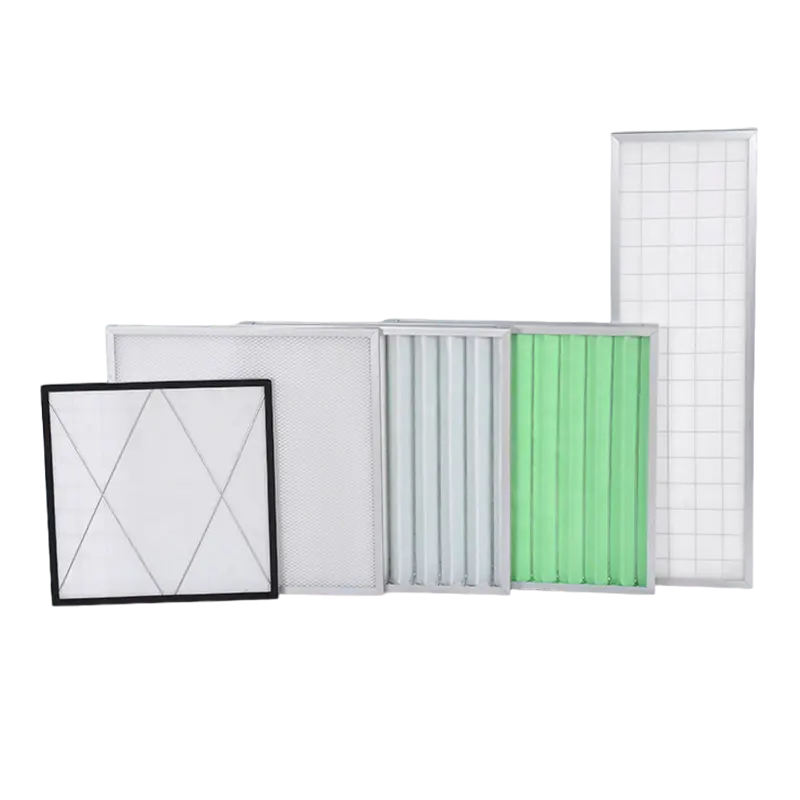
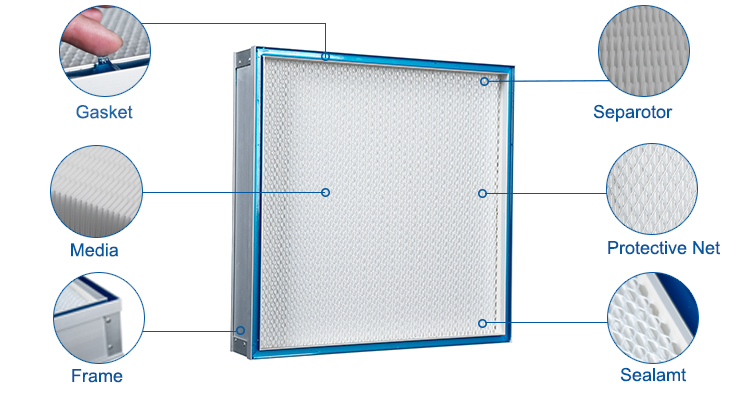
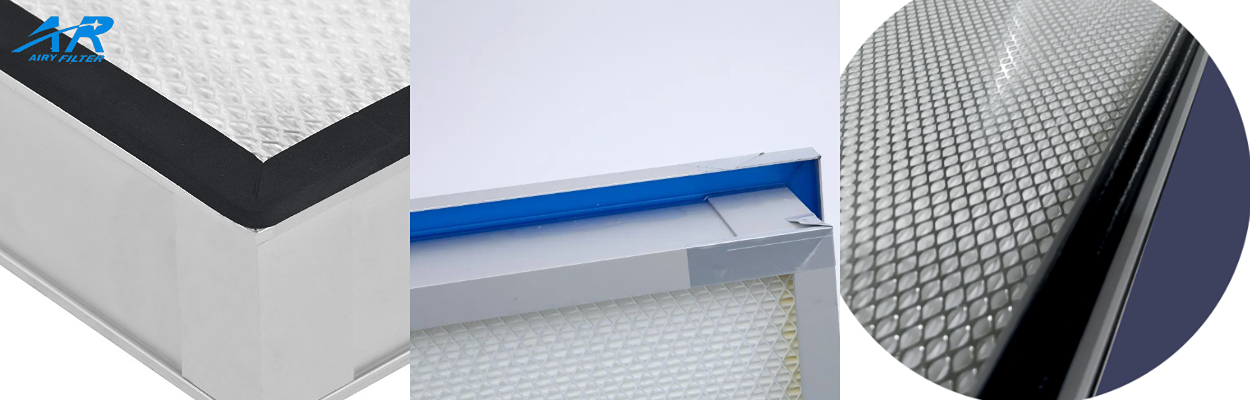
Four physical fields must match the terminal you are replacing or building. These are external width and height, depth, the tolerance the supplier actually holds, and the frame construction: anodized aluminum, galvanized, stainless, or ABS. Mini-pleat packs and gel-seal cases are different builds, and they hand off to the grid differently. Then the interface: where the seal sits, how it is clamped, and which direction the air must pass. The measurement discipline is the same one we cover at the HVAC end of the range; the principle tightens as the class rises.
Tolerance deserves its own numeric cell for exactly this reason: fit is a two-sided question. The delivered frame may sit at one end of the supplier’s band while your housing opening sits at the other end of yours. A nominal “610” on both papers can still hide millimeters that decide whether a gel knife-edge drops into its channel or lands on paint. Specify the unit tolerance and the interface tolerance as separate fields. On receipt, verify both before the installation crew opens packaging. A measured frame and a checked grid mouth cost two minutes; a misfit unit found at 2 a.m. during a shutdown costs the night.
A persistent misconception to strike from your sheet: H14 does not require a gel seal. The efficiency class and the sealing method belong to different fields. Airy sells an H14-rated mini-pleat line and a gel-seal mini-pleated line, and the product pages state sizes and airflows, not the sealing interface. For any H14 HEPA filter candidate, have the supplier state in writing how that model seals and how the clamped leak path is verified.
Check the Evidence Behind the H14 Claim
Ask the datasheet for its citation trail: which model, which standard, which report, which serials.
Four checkpoints keep an H14 claim verifiable without turning your purchase file into a laboratory handbook. First, a model code, not a brochure title: the datasheet row should name the same product identity that will appear on labels and reports. Second, the standard and part the class is claimed against, cited by name. EN 1822 or ISO 29463, with the part, is what belongs in that cell. Third, the finished-unit efficiency figure and its MPPS basis, rather than a media certificate alone. Media efficiency describes the paper; finished-unit efficiency describes the product. Fourth, the leak-testing evidence for the individual units: which units were scanned, under what method, and whether certificates carry serial numbers you can match to the crates.
How those factory tests are actually run belongs to a separate document. Our guide to HEPA filter testing carries the test-side detail. It covers what a scan checks, what an efficiency report must state, and how installed testing differs from anything the factory can ship with. This sheet does not duplicate it. At the ordering stage you only have to state which report types must accompany delivery; the method discussion happens on the other page.
Turn the four checkpoints into purchase-order language by naming the artifacts, not the intent. A workable clause reads like a list of attachments with blanks filled in. It names the datasheet for model [code], issued for this order. It adds a per-unit test record showing efficiency at [airflow] and resistance at [airflow]. It ends with a per-unit leak-scan certificate bearing serial [range], plus a packing list referencing the same serials. Every element is checkable at goods-receipt by someone with no laboratory background, which is exactly the property acceptance paperwork needs. A clause that says only that the filters shall be H14 tested transfers the definition of done to the supplier. That is the outcome this whole sheet exists to prevent.
Complete an H14 Ordering Specification Sheet
One page, four columns: what the item requires, what you can state today, what the supplier must confirm, and what is still open.
Fill the buyer column before you send a single inquiry. Make the supplier counter-sign column by column. Any blank that lands in “to confirm” is a known risk, which beats a silent default.
| Specification item | Buyer states | Supplier confirms | Commonly missed |
|---|---|---|---|
| Class and standard | H14 per EN 1822 (or ISO 29463), part quoted | Model code carrying that class | Class quoted without naming the standard |
| Airflow / resistance pair | Duty airflow in m³/h; max initial ΔP; final-ΔP replacement limit | Both figures at your stated airflow and units | Comparing datasheets at different test airflows |
| Dimensions and tolerance | W×H×depth, units, tolerance you accept | Actual built size vs nominal | Assuming nominal equals actual (see our HEPA filter sizes guide) |
| Frame and media construction | Frame material, separator type, moisture exposure | Construction drawing or photo of the exact build | Frame substitutions accepted silently at reorder |
| Seal and mounting interface | Gasket or gel, gasket position, clamp method, airflow direction | Interface sketch or standard detail matched to housing | Ordering “H14, gel seal” because a past project used one |
| Reports and serials | Which test documents must ship with the units, named by type | Report format sample before production | Requiring “a test report” without saying which of the three |
| Quantity, packaging, direction marks | Order split, crate protection, airflow arrow labeling | Packaging spec and labeling language | Installation-side arrow marks left to memory |
Airy HEPA Filter Solutions
Airy provides customized HEPA filtration solutions to help cleanroom and industrial facilities control filter performance, maintain stable airflow, and improve acceptance in demanding production environments.
Filter Lines for Terminal and Housing Duties
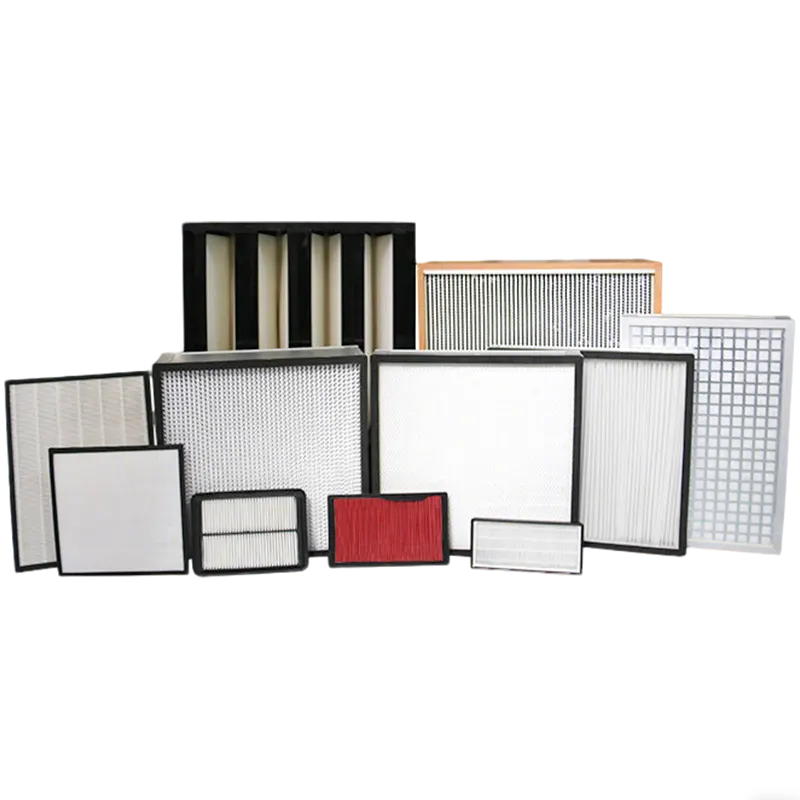
H14 orders typically settle on one of two published constructions. Both ship in the standard 610×610 format, and both list additional sizes around it.
- Gel-Seal Mini-Pleated Units: the published gel-seal line covers case depths of 90 and 93 mm. Each listed size carries its own rated airflow pair.
- Mini-Pleat Framed Panels: this line is listed in 50, 70 and 90 mm depths. The same footprint can carry a different rated airflow range than the gel-seal case.
- Additional Formats: the HEPA and cleanroom filters catalog lists more sizes and related classes for housing and terminal duties.
Matching the line to the housing interface is the first decision, before any efficiency figure is compared between offers.
Customized Solutions for Different Facilities
Cleanroom, laboratory, and industrial equipment duties differ in housing, airflow, and paperwork. Airy supports customized builds for such applications, and the main fields include:
- Format and Tolerance: custom formats are negotiated against drawings. Have every tolerance band confirmed in writing.
- Frame and Construction: frame material and construction are matched to the housing and the operating environment.
- Airflow and Resistance: builds are aligned to your stated duty airflow and resistance limits rather than datasheet averages.
Documentation, Testing, and Long-Term Operation
An accepted H14 unit needs evidence as well as fit. Test documentation is aligned to the fields in the specification sheet above, per unit and by serial number.
- Efficiency Records: finished-unit results are issued at the rated airflow, tied to the ordered model code.
- Leak-Scan Certificates: per-unit scans carry serial numbers that match the delivered crates at goods-receipt.
- Change-Out Records: final-resistance limits can be written into the maintenance plan on your sheet.
OEM Filtration Support for Industrial Partners
Beyond catalog units, Airy provides OEM and customized filtration support for distributors and equipment builders, and has produced custom air filter media since 2009. The team can assist with media selection, construction design, sample testing, and documentation to match specific housing requirements.
Frequently Asked Questions
What efficiency does H14 mean?
Under EN 1822, an H14 HEPA filter must reach at least 99.995% efficiency at its most penetrating particle size (MPPS). That point is measured for the specific construction. It is not a fixed 0.3 μm figure across all filters, as older specifications used to assume.
Is the pressure drop the same for all H14 filters?
No. Resistance depends on the model’s construction and on the airflow it was tested at. Airy’s gel-seal datasheet lists two initial resistance values for one model, each tied to its own rated airflow. Compare only figures recorded at the same airflow, units, and clean or used condition.
Does H14 require a gel-seal (liquid-sealed) frame?
No. The efficiency class and the sealing method are separate fields on the order. Gel-seal mini-pleated units and mini-pleat framed units both carry H14 ratings in Airy’s catalog. Order the interface your housing accepts, then have the sealing method confirmed in writing.
Can I replace an H13 unit with H14 directly?
Only after a full review of two field groups: the footprint and depth, and the resistance at your actual airflow. Higher classes commonly add pressure drop, so check that the fan absorbs it. Treat the swap as a specification review, not a part-number substitution.
Which documents should I require with the order?
Require a datasheet row for the exact model, with class, rated airflow, resistance figures and dimensions. Add the finished-unit efficiency record and per-unit leak-scan certificates tied to delivered serials. Name each report type on the purchase order itself, so nothing is left to be inferred at goods-receipt.