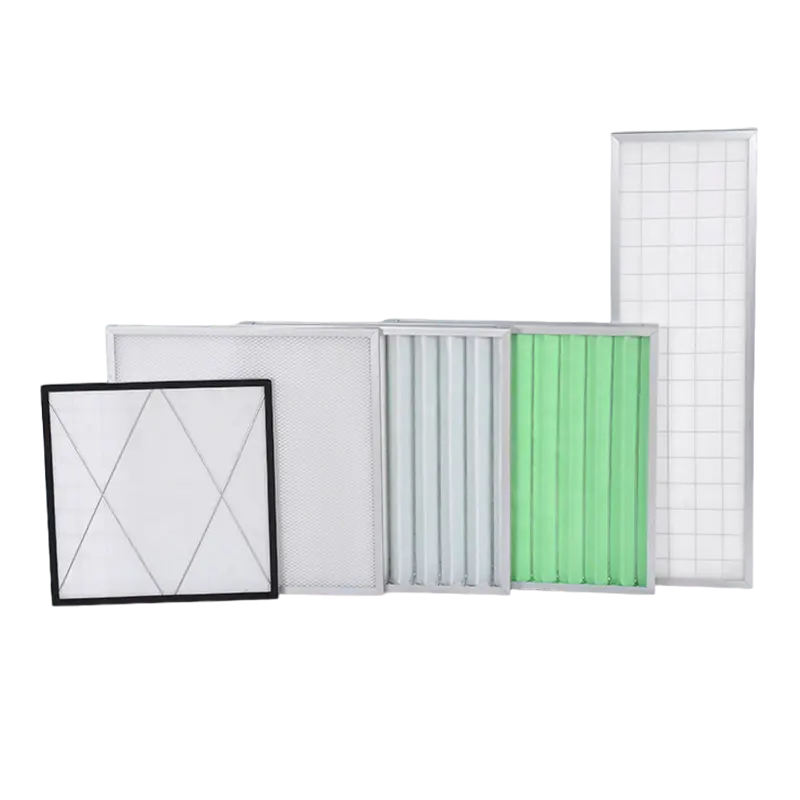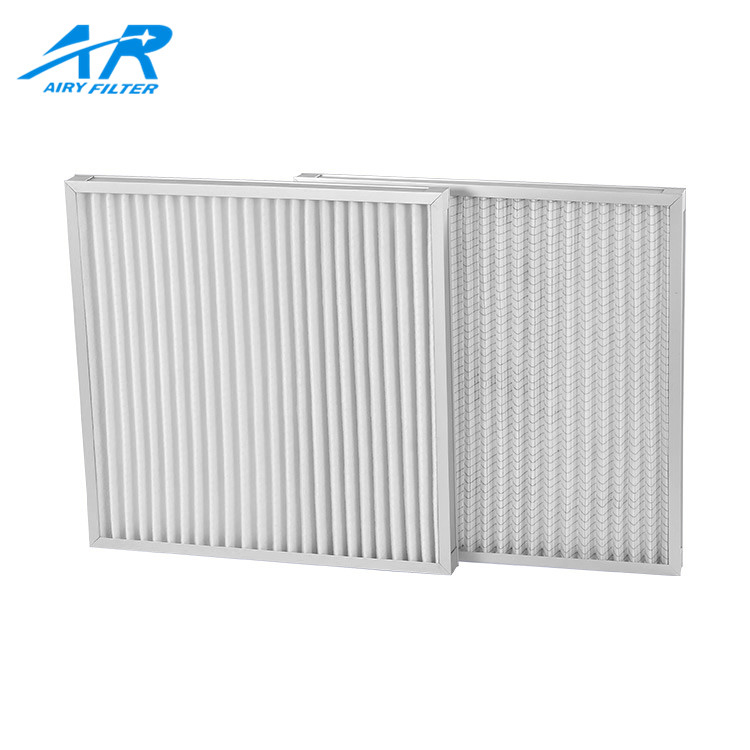
In high-precision manufacturing, pharmaceutical production, and cleanroom environments, strict particulate control is essential for preventing contamination and maintaining regulatory compliance. Cleanroom HEPA filters provide critical air purification by capturing sub-micron particles, microorganisms, and airborne contaminants in controlled environments.
Selecting the right HEPA filter for clean room applications requires careful evaluation of filtration efficiency, filter ratings, frame designs, seal configurations, airflow capacity, and certification requirements. In this guide, we explain key specifications of HEPA filters for cleanrooms, including EN1822 efficiency classes, structural types, sizing considerations, and sourcing factors to help engineers and buyers choose the right filtration solution.
What is a Cleanroom HEPA Filter?
A cleanroom HEPA filter is a high-precision air filtration unit designed to capture sub-micron particles, microorganisms, and other airborne contaminants in controlled environments.
As a critical component of cleanroom filtration systems, HEPA filters for cleanrooms use ultra-fine glass fiber media to trap particles through three primary mechanisms: interception, impaction, and diffusion.
Core Components and Construction of Cleanroom HEPA Filters:
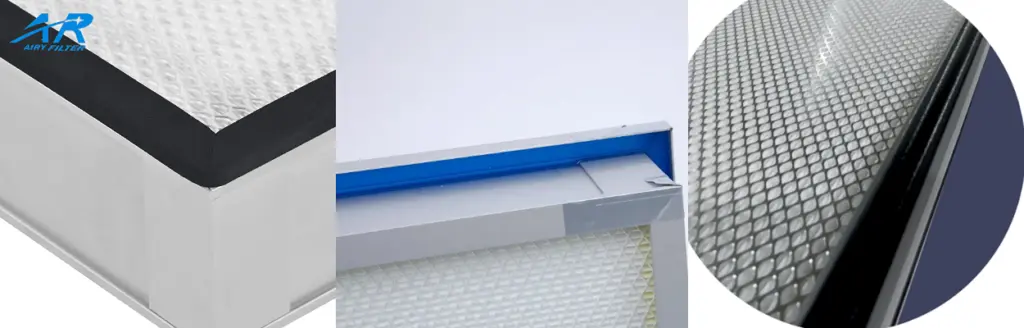
- Filter Media: Sub-micron micro-glass fiber media with highly uniform pore distribution and excellent moisture resistance, providing reliable particle capture performance.
- Media Separators: Continuous hot-melt adhesive threads for mini-pleat HEPA filters or corrugated aluminum foil separators for deep-pleat HEPA filters, ensuring consistent airflow distribution.
- Frame Materials: Anodized aluminum alloy extrusions, 304/316 stainless steel, galvanized sheet metal, or wooden core frames selected according to different cleanroom application requirements.
- Sealing and Gaskets: Self-healing liquid polyurethane gel seals, PU foam gaskets, or seamless neoprene rubber gaskets designed to prevent air bypass and maintain cleanroom integrity.
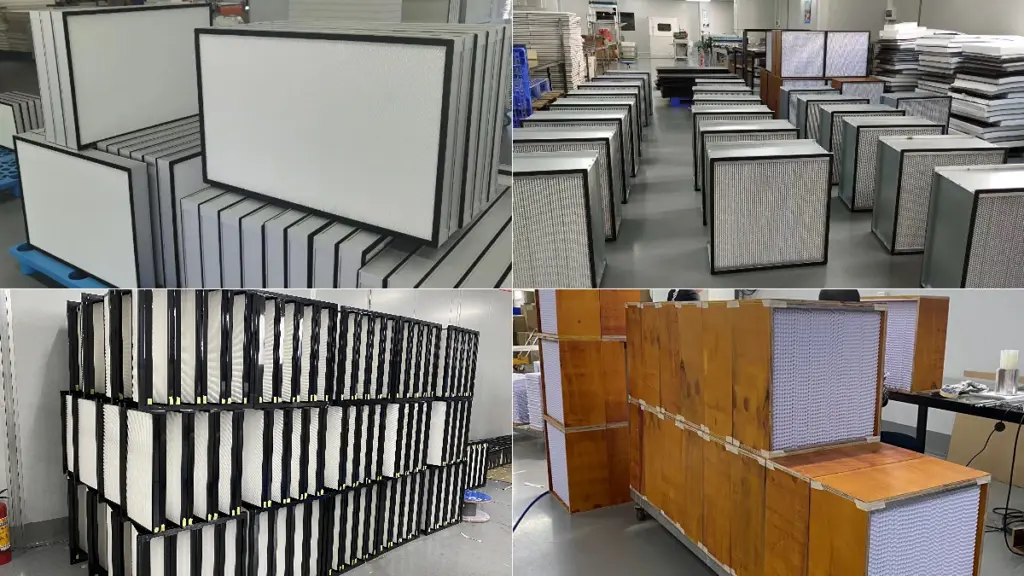
HEPA Filter Ratings and Certification Standards: EN1822, IEST, and ISO
HEPA filter ratings define the filtration efficiency and classification requirements of cleanroom filters. Standards such as EN1822, IEST-RP-CC001, and ISO 14644-1 are commonly used to evaluate HEPA and ULPA filter performance. The table below summarizes common filter grades, efficiency levels, and applications.
| Filter Class (EN1822) | MPPS Efficiency | IEST Equivalent | ISO Cleanroom Class | Typical Applications |
|---|---|---|---|---|
| H13 HEPA | ≥99.95% | Type C (≈99.99%) | ISO Class 7–8 | General cleanrooms, medical devices, HVAC final filtration |
| H14 HEPA | ≥99.995% | Type K / Type D | ISO Class 5–6 | Pharmaceutical filling, operating rooms, FFU systems |
| U15 ULPA | ≥99.9995% | Type F | ISO Class 3–4 | Semiconductor fabs, photolithography, advanced manufacturing |
Types of HEPA Filters for Cleanroom Applications
Cleanroom HEPA filters are available in different structural designs to meet various airflow, installation space, and filtration requirements. The two most common configurations used in pharmaceutical, semiconductor, medical, and industrial cleanrooms are mini-pleat and deep-pleat HEPA filters.
Mini-Pleat HEPA Filters
Mini-pleat HEPA filters use closely spaced media folds separated by continuous hot-melt adhesive threads. This compact design increases the effective filtration area while maintaining low airflow resistance, making them suitable for cleanrooms where installation space and energy efficiency are important.
Key Advantages:
- Compact Design: Suitable for applications with limited ceiling depth or restricted installation space.
- Low Pressure Drop: The optimized pleat structure helps reduce airflow resistance and improve HVAC energy efficiency.
- Stable Airflow Performance: The uniform media arrangement supports consistent airflow distribution.
Typical Applications: Terminal ceiling modules, clean benches, and cleanroom fan filter units (FFUs).
Deep-Pleat HEPA Filters
Deep-pleat HEPA filters use deeper media packs supported by corrugated aluminum separators to increase filtration area and dust-holding capacity. Compared with mini-pleat designs, they are better suited for systems requiring higher airflow capacity, longer service life, and stronger structural performance.
Key Advantages:
- High Airflow Capacity: Suitable for large-scale HVAC systems requiring higher filtration volume.
- Greater Dust-Holding Capacity: The deeper media structure helps extend filter replacement intervals.
- Strong Structural Stability: Aluminum separators maintain filter geometry under demanding operating conditions.
Typical Applications: Central air handling units (AHUs), industrial cleanrooms, and high-volume filtration systems.
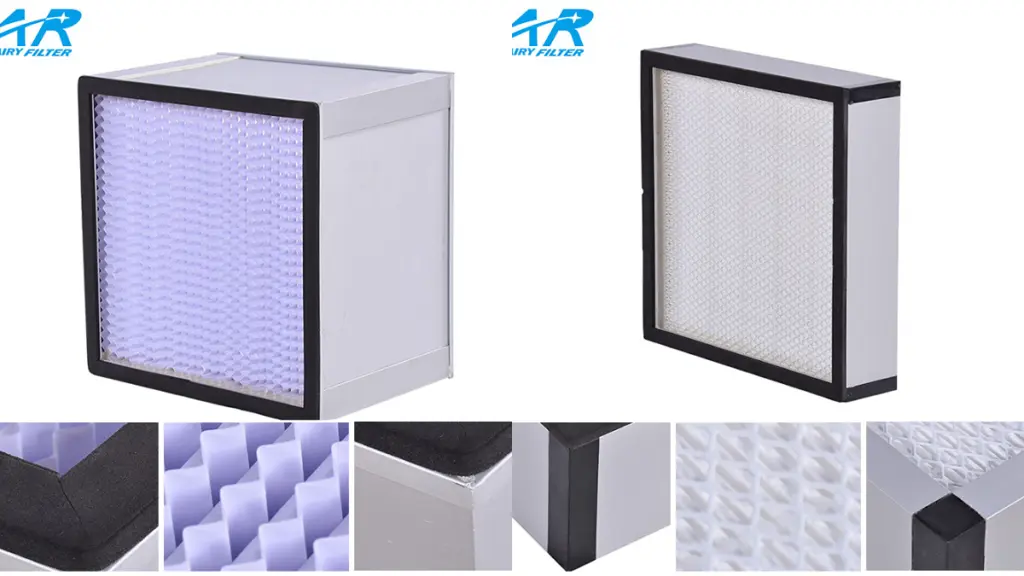
HEPA Filter Seal Options and Gasket Configurations
HEPA filter seals help prevent air bypass and maintain cleanroom filtration performance. Common sealing solutions include liquid gel seals, neoprene rubber gaskets, and polyurethane foam gaskets, each designed for different installation requirements and cleanroom applications.
Liquid Gel Seal (Fluid Seal)
Liquid gel seal HEPA filters use a filter frame channel filled with self-healing polyurethane or silicone gel. During installation, the gel seal engages with a knife-edge grid system to create a continuous sealing interface and reduce air leakage.
Key Features:
- Excellent Leakage Control: Provides a highly reliable seal for critical environments where bypass prevention is essential.
- Self-Healing Performance: The gel material can recover after minor deformation, helping maintain long-term sealing performance.
Applications: Commonly used in ISO Class 5 cleanrooms, sterile pharmaceutical facilities, and high-performance terminal filtration systems.
Neoprene Rubber Gasket (EVA)
Neoprene rubber gasket HEPA filters use a seamless gasket strip that compresses against the filter housing frame to prevent air leakage. This sealing method provides a practical solution for standard cleanroom installations that require reliable performance and easy maintenance.
Key Features:
- Cost-Effective Solution: Provides dependable sealing performance with a simpler installation structure.
- Easy Maintenance: Suitable for systems requiring regular filter replacement or side-access servicing.
Applications: Widely used in standard terminal modules, side-access filter banks, laboratories, and general cleanroom HVAC systems.
Polyurethane Foam Gasket (PU Foam)
Polyurethane foam gasket HEPA filters use a continuous liquid-dispensed gasket applied directly onto the filter frame through automated manufacturing processes. After curing, the PU foam forms a flexible and durable jointless seal with excellent elastic recovery.
Key Features:
- Flexible Sealing Performance: Maintains close contact with the housing surface under different operating conditions.
- Strong Elastic Recovery: Helps compensate for installation variations and mechanical vibration.
Applications: Suitable for high-vibration systems, industrial cleanrooms, and applications requiring reliable long-term sealing performance.
How to Select the Right HEPA Filter for Your Cleanroom
Selecting the right cleanroom HEPA filter requires evaluating airflow requirements, filter dimensions, pressure drop, and application conditions. Engineers should consider cleanroom volume, required air changes per hour (ACH), and HVAC system design to determine the most suitable HEPA filter specifications.
Calculate Cleanroom Airflow Requirements
Determining the required airflow is the first step when selecting cleanroom HEPA filters. The calculation depends on cleanroom volume, target ISO cleanliness class, and required air changes per hour (ACH).
Step 1: Calculate Cleanroom Airflow Volume
The total airflow requirement can be calculated using the following formula:
Q (m³/h) = Cleanroom Volume (m³) × Required ACH
Typical air change requirements vary according to cleanroom classification:
| Cleanroom Classification | Typical Air Changes per Hour (ACH) | Typical Applications |
|---|---|---|
| ISO Class 8 | 10–25 ACH | General manufacturing areas and controlled environments |
| ISO Class 7 | 30–60 ACH | Medical device production and pharmaceutical processing areas |
| ISO Class 5 | 240–360 ACH or 0.35–0.55 m/s laminar airflow | Sterile pharmaceutical filling and high-precision cleanroom applications |
Step 2: Determine Required HEPA Filter Quantity
After calculating the total airflow requirement, the required number of HEPA filters can be determined using the following formula:
Filter Quantity = Total Airflow Volume (Q) ÷ Rated Filter Airflow Capacity
For example, if a cleanroom requires 6000 m³/h of airflow and each HEPA filter provides 1200 m³/h:
6000 ÷ 1200 = 5 HEPA filters
This calculation helps engineers determine the required number of filtration units while ensuring sufficient airflow distribution and contamination control.
Select the Right HEPA Filter Size and Airflow Capacity
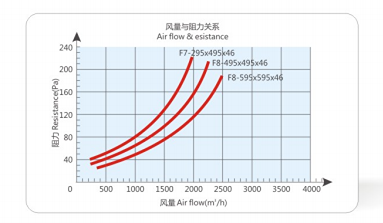
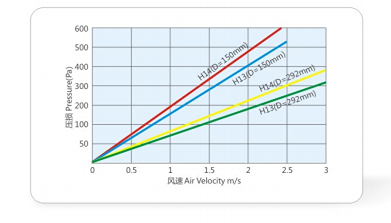
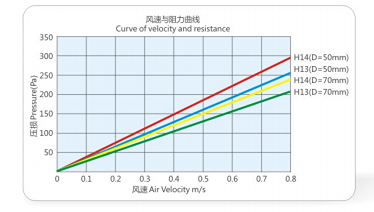
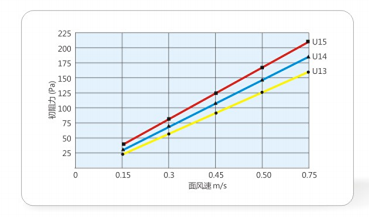
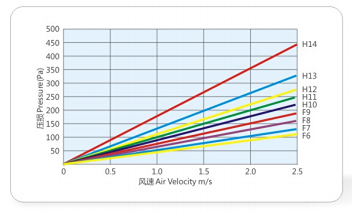
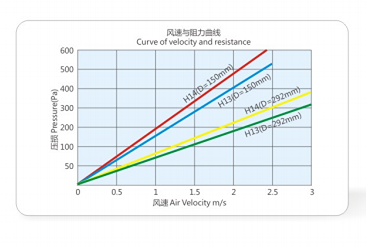
After determining the required airflow volume, engineers need to select HEPA filter dimensions and airflow specifications that match the cleanroom HVAC system. Filter size, rated airflow, and initial resistance directly affect HVAC compatibility, energy consumption, and overall cleanroom filtration performance.
Common cleanroom HEPA filter specifications include:
| Nominal Size (mm) | Nominal Size (Inches) | Rated Airflow | Rated Airflow (CFM) | Initial Resistance | Structure |
|---|---|---|---|---|---|
| 610 × 610 × 69 | 24″ × 24″ × 2.7″ | 600 m³/h | 350 CFM | ≤110 Pa | Mini-Pleat |
| 1220 × 610 × 69 | 48″ × 24″ × 2.7″ | 1200 m³/h | 700 CFM | ≤110 Pa | Mini-Pleat |
| 1170 × 570 × 69 | 46″ × 22.5″ × 2.7″ | 1000 m³/h | 590 CFM | ≤110 Pa | Mini-Pleat (FFU) |
| 610 × 610 × 150 | 24″ × 24″ × 6″ | 1000 m³/h | 590 CFM | ≤180 Pa | Deep-Pleat |
| 610 × 610 × 292 | 24″ × 24″ × 11.5″ | 1500 m³/h | 880 CFM | ≤220 Pa | Deep-Pleat |
When selecting HEPA filter sizes, engineers should ensure compatibility with ceiling grids, FFU housings, or air handling units. Lower initial resistance can also help reduce HVAC energy consumption during long-term operation.
Scroll to view more data:
Match HEPA Filter Selection with Application Requirements
Different cleanroom applications require specific filtration efficiency, airflow capacity, and structural designs. The selected HEPA filter should match the contamination control level, system requirements, and industry standards.
Common Selection Factors:
- Pharmaceutical and Medical Facilities: H13 or H14 HEPA filters are commonly selected for sterile environments, filling areas, and operating rooms.
- Semiconductor and Electronics Manufacturing: U15 ULPA filters are used for applications requiring extremely low particle levels and advanced contamination control.
- Industrial Cleanrooms: Mini-pleat or deep-pleat HEPA filters are selected based on installation space, airflow requirements, and service life expectations.
Key Factors When Choosing a Cleanroom HEPA Filter Supplier
When evaluating an OEM cleanroom air filter supplier or placing bulk wholesale orders, engineering teams should verify:
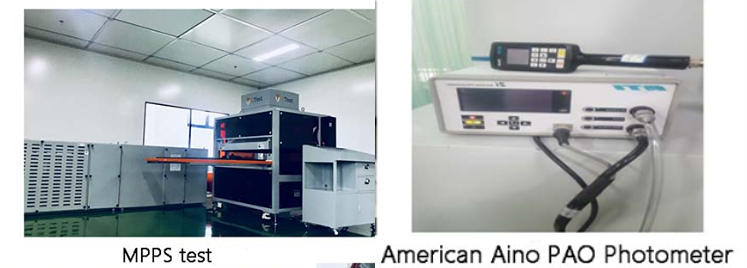
- 100% Individual Scan Leak Testing: Ensure every H13/H14 HEPA filter undergoes automated EN1822 MPPS or DOP / PAO photometer leak scanning, complete with individual serial-numbered test certificates.
- Low Initial Pressure Drop: Opt for uniform mini-pleat geometry to minimize HVAC fan static resistance, drastically reducing annual cleanroom energy consumption.
- Dust-Free Cleanroom Packaging: Filters must be double-bagged inside ISO Class 7 cleanroom packaging to eliminate contamination risks during sea freight and international transit.
Why Partner with AiryFilter as Your HEPA Filter Manufacturer?
Guangzhou Airy Filter Media Co., Ltd. specializes in manufacturing high-efficiency cleanroom filtration products designed to meet strict international compliance requirements, including ISO 14644-1, EN1822, and CE standards.
With professional manufacturing capabilities and customized solutions, Airy supports global customers with reliable HEPA filters for cleanroom, HVAC, and industrial applications.
- Direct Source HEPA Manufacturer: Competitive factory-direct wholesale pricing with full raw material traceability.
- Full-Spectrum Air Filtration: Complete catalog ranging from G4 panel pre-filters and F7 pocket filters to H13/H14 HEPA and U15 ULPA modules.
- 100% Factory Quality Assurance: Every HEPA unit is individually tested for pressure drop, airflow resistance, and particle penetration.
- Custom OEM/ODM Engineering: Custom dimensions, specialized frame depths, fluid-seal channels, and private labeling for international B2B clients.
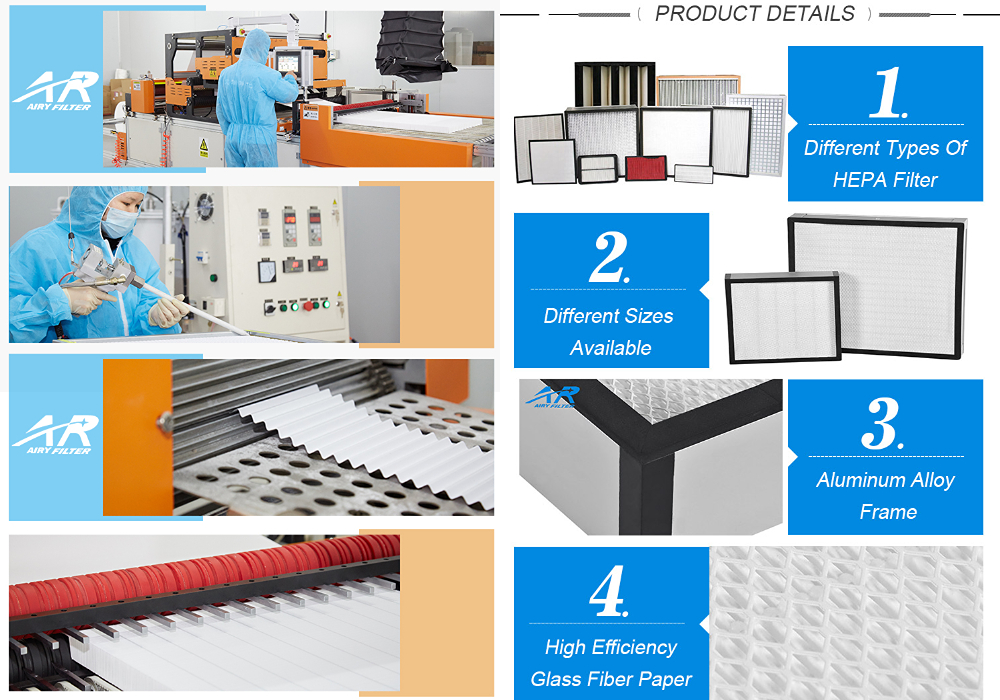
With state-of-the-art facilities and rigorous quality control, we ensure high-performance filtration solutions tailored to your needs. Explore Airy‘s Advanced Manufacturing for Superior Filtration.
Frequently Asked Questions
What is the average lifespan of a cleanroom HEPA filter?
In standard ISO Class 7/8 cleanroom environments with proper G4/F7 pre-filtration, cleanroom HEPA filters typically last between 3 to 5 years. Replacement is mandated when final resistance reaches double the initial pressure drop (e.g., 250 – 300 Pa) or during PAO leak audit failures.
What is the main efficiency difference between H13 and H14 HEPA filters?
H13 HEPA filters offer ≥ 99.95% efficiency at MPPS (Most Penetrating Particle Size), making them suitable for ISO Class 7/8 facilities. H14 HEPA filters provide ≥ 99.995% efficiency at MPPS (10 times lower particle penetration), which is required for ISO Class 5 sterile pharma filling and semiconductor production.
When should I choose Gel Seal over Gasket Seal HEPA filters?
Gel seal HEPA filters are recommended for top-loading ceiling grid installations in critical ISO Class 5 cleanrooms where zero bypass is mandatory. Neoprene or PU foam gaskets are ideal for side-access housing units or standard ceiling modules with clamping mechanisms.
Can Airy Filter provide custom OEM HEPA filter sizes and private labeling?
Yes, as a direct source HEPA filter manufacturer, Guangzhou Airy Filter provides full OEM/ODM customization for dimensions, frame depths (aluminum, stainless steel), fluid gel channels, and private label branding for global distributors.