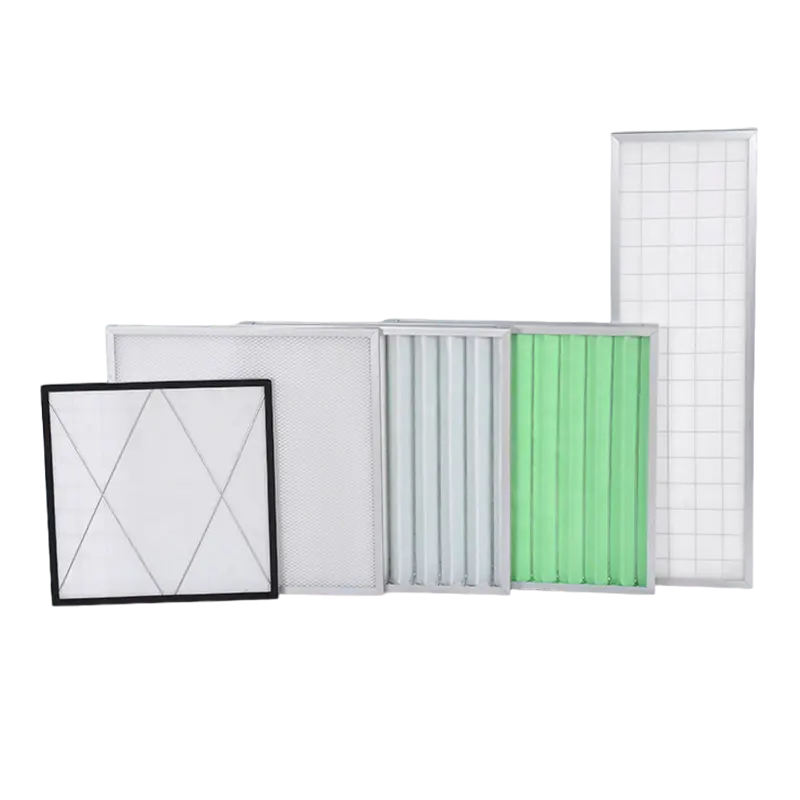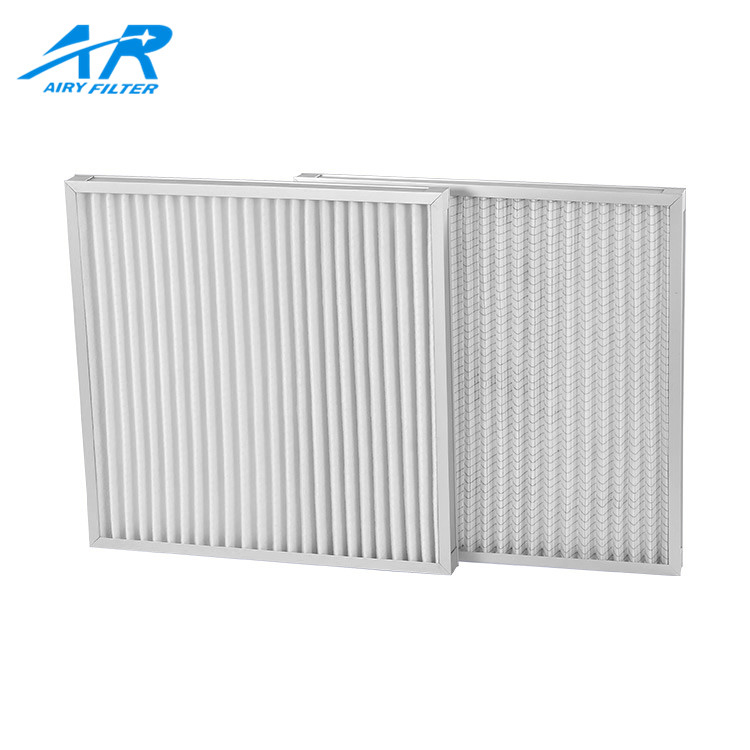
HEPA filter testing covers three different tests that answer three different questions. A factory efficiency test tells you whether the whole filter meets its claimed grade. A factory leak scan tells you whether that individual unit has a local defect. An installed integrity test tells you whether the filter, once mounted in your housing, is sealed with no bypass. A report from any one of them says nothing about the other two, and none of the three can be traded for another.
For a buyer accepting an order, the practical job is smaller than the laboratory. Know which HEPA filter testing document answers which question, and check that it carries the fields that tie it to the unit in your hands. This article separates the three tests and ends with a report-checking sequence you can run before sign-off.
주요 시사점
- Three tests, three scopes: whole-unit efficiency, per-unit local leaks, and as-installed sealing are measured separately. A pass on one is not a pass on the others.
- MPPS is measured, not assumed: the most penetrating particle size is a property of a specific construction, not a universal 0.3 μm.
- A report is only as good as its identifiers: model, serial number, method, and test conditions must tie the paper to the unit delivered.
Three HEPA Filter Tests That Answer Different Questions
Before comparing any two documents, confirm which of the three questions each one was built to answer.
Classification standards such as EN 1822 and the parallel ISO 29463 series define how a HEPA filter’s efficiency is measured and graded. The standard does not tell you which stage of the transaction a given report covers. The table below splits the three tests a buyer will actually meet. If you are still deciding what to put on an order sheet rather than how to read reports, 우리의 H14 HEPA filter specifications guide carries the ordering fields.
| 시험 | Object measured | Question it answers | What it cannot prove |
|---|---|---|---|
| Factory efficiency test | A whole filter unit, or a sample of a batch | Does the filter meet its claimed grade overall? | That your specific unit has no small local defect |
| Factory leak scan | One finished unit, scanned zone by zone | Is there a pinhole, tear, or seal defect in this unit? | How the unit will perform once mounted in your housing |
| Installed integrity test | The filter as installed, plus its mounting interface | Is the system sealed, with no bypass around or through the installation? | Anything about the factory’s production discipline for other units |
The three rows explain a lot of acceptance disputes. A buyer holding a batch efficiency report argues that the filter passed. The seller’s leak-scan certificate answers only that this unit passed. Neither document addresses the gasket surface painted over at installation. Keep the three scopes apart from the first email.
Factory Efficiency Testing: Does the Filter Meet Its Claimed Grade?
Efficiency testing grades the whole filter against a standard; the number is only meaningful with its method, 기류, and particle basis attached.
In an efficiency test, a challenge aerosol is introduced upstream of the filter, and particle counts upstream and downstream give penetration and, by subtraction, 능률. Under EN 1822, the headline figure is stated at the filter’s most penetrating particle size (MPPS). The MPPS is found by testing across a particle-size range and locating the worst case. It is a property of a specific media-and-pleat construction, and it varies between designs. It is not 0.3 μm as a universal constant. That fixed figure comes from older specifications, and a datasheet citing a fixed-size efficiency quotes legacy practice rather than an EN 1822 result. H14, for instance, means at least 99.995% efficiency at the unit’s measured MPPS.
Two distinctions keep efficiency paperwork honest. 첫 번째, the test airflow matters, and the report should match the rating you ordered against. The same filter can look different at 1,000 m³/h than at its rated condition. 두번째, a media test certificate is not a finished-filter test report. Media efficiency belongs to the sheet, and the finished assembly adds pleating, separators, sealant, and frame, any of which can shift performance. Airy’s factory practice, described in our cleanroom HEPA filter guide, tests the individual unit. The guide states that every HEPA unit is individually tested for pressure drop, 기류 저항, 및 입자 침투.
When a HEPA filter testing report lands in your inbox, the grade claim is only the first line. The test method named, the airflow, the particle counting range, and the sample identity are what let you reuse the number in your acceptance file.
Factory Leak Testing: Are There Local Defects?
Overall efficiency grades the average. Leak testing hunts the exceptions, such as the one pinhole a batch average happily hides.
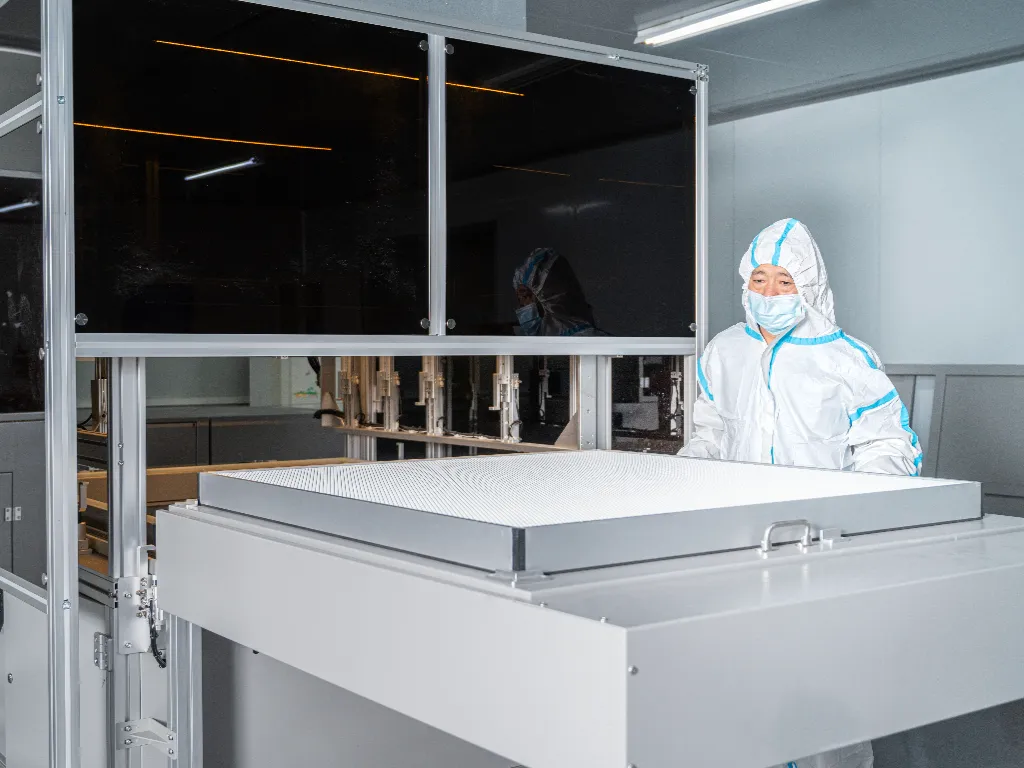
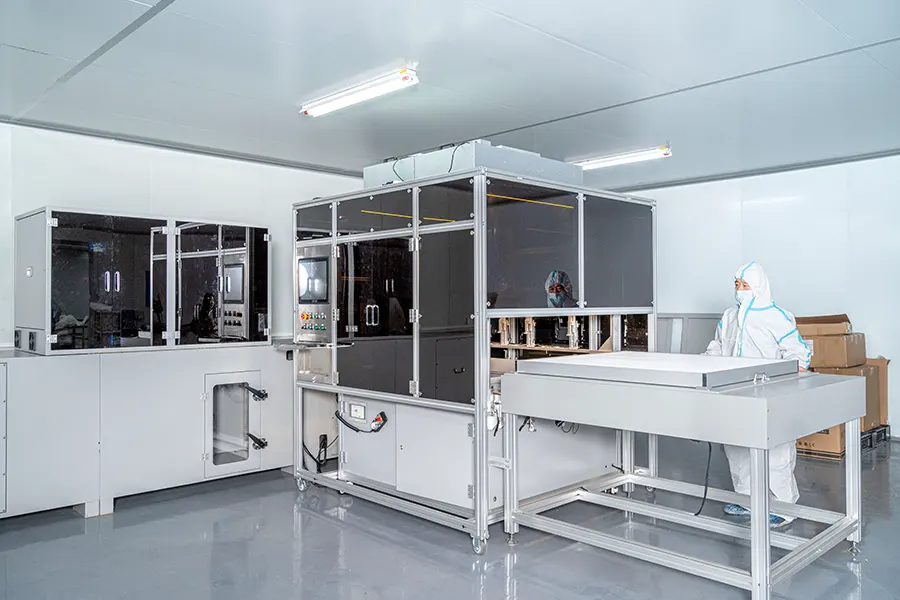
A filter can pass an efficiency test at 99.99% and still contain a defect the size of a pinhead. The average swallows a tiny local jet of unfiltered air. Leak scanning exists to find that jet. In a scan-type leak test, a challenge aerosol is fed upstream while a sampling probe scans the downstream side. The probe walks the filter face, the pleat edges, the sealant lines, and the media-to-frame bond. Defects realistically appear there: a nick in the paper, a channel in the adhesive bead, a separator edge lifting. An automated scan line sweeps the unit’s downstream zones and records penetration by location. That is why a serious factory scan produces a per-unit result, not a batch blessing.
The value of the scan is its link to one serial number. Airy’s HEPA units leave the line with individual scan leak tests against either the EN 1822 MPPS challenge or a DOP/PAO-type photometer scan. The practice is documented with serial-numbered test certificates, as stated in the cleanroom guide. The supplier also lists optional scanning reports in our H13 vs H14 comparison, alongside the individual leak tests. When you require such a report on the purchase order, the certificate number should physically appear on, or be traceable to, the unit in the box.
One boundary: the scan tests the unit on the bench, downstream of nothing but the test housing. Your ceiling grid, gasket groove, clamps, and installation crew are outside that scope. That gap is why the third test exists.
Installed Integrity Testing: Is the Filter System Properly Sealed?
The factory proved the filter. Only an installed test can prove your system.
Installed integrity testing checks the filter and its mounting together: the media, the frame seals, the gasket interface, the housing flange, and any clamping hardware. A unit that scanned clean at the factory can leak in service for purely installation reasons. Think of a compressed gasket that never met the flange, a frame screwed onto an uneven surface, a protective film left over a seal face, or damage during handling.
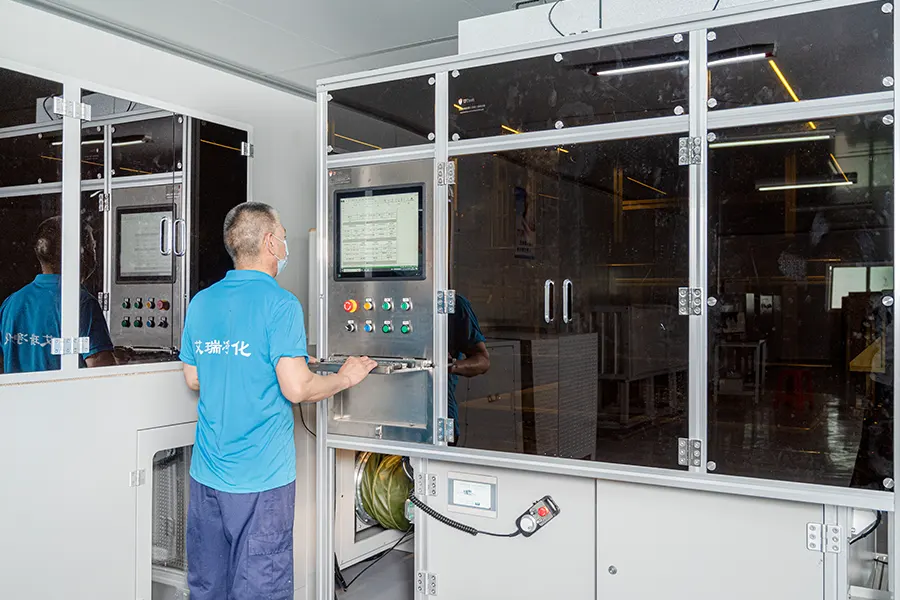
Field testing of this kind follows standards such as ISO 14644-3 for cleanroom device qualification. A local validation contractor usually runs it, rather than the filter factory. You will meet the terms PAO and DOP in that context. They name the challenge aerosols commonly used for field scanning, and DOP (다이옥 프탈레이트) is the older aerosol retained in the industry’s vocabulary. Polyalpha-olefin (PAO) is the common modern substitute, and DEHS is another widely used fluid. Check which aerosol your acceptance documents name, because that is the buyer-level decision. Burn rates, probe handling, and hot-spot calculation belong to the contractor’s method statements, not to this purchasing discussion.
The consequence for procurement is clear: no factory certificate transfers to the as-installed condition, no matter how diligent the bench work. If your project requires installed testing, decide who runs it and on which acceptance limits before the filters arrive. The filters will be tested by whatever your specification says they must survive.
How to Check a Test Report Before Accepting an Order
Six fields turn a piece of paper into acceptance evidence. Work them in order, because anything that fails a field is a question, not a rejection.
The sequence below works on every document type in this article, from efficiency reports to leak-scan certificates and field-test records alike. It is deliberately boring, which is what lets you run it at goods-receipt with a printed packing list in one hand and the report in the other.
| # | Field to check | Pass condition | Typical failure this catches |
|---|---|---|---|
| 1 | Model and serial identity | Exact model plus the serials delivered, 예를 들어. the gel-seal H14 line | A generic datasheet presented as a test report |
| 2 | Test type | Document states which of the three tests it represents | Batch efficiency offered as proof of a per-unit scan |
| 3 | Method and standard | Named standard and method part, or the contractor’s method reference | No citation behind a tested claim |
| 4 | Conditions | Test airflow and particle basis stated; airflow matches the rating you bought | An efficiency figure taken at an airflow unrelated to duty |
| 5 | 결과 | Numbers with units: efficiency or penetration, local-leak limit, 저항 | A PASS stamp with the underlying values omitted |
| 6 | Acceptance basis | Report criteria equal order criteria — the same class or figure | Order says H14; report certifies against H13 thresholds |
Three warning patterns recur across supplier paperwork. The first is marketing sheets and logo certificates with no measured values. The second is a report missing its conditions, which leaves the number floating free of any airflow. The third is paperwork whose serials do not match the delivered units. Any of the three turns the document from acceptance evidence into a question to close before sign-off.
자주 묻는 질문
Does an efficiency report prove a leak test passed?
아니요. Efficiency grades the whole unit’s average performance, while a leak scan hunts the local defects that an average can hide. They are different measurements answering different questions, and one never substitutes for the other in a project acceptance file.
Can the factory’s leak scan replace installed testing?
아니요. The factory scan proves the unit was sound on the bench. Installed integrity testing covers what the factory cannot see: the gasket interface, housing flange, clamps, and handling damage after mounting. Projects that require field verification need both records before sign-off.
What is the difference between PAO and DOP?
Both are names for challenge aerosols used in leak testing. DOP (다이옥 프탈레이트) is the older fluid that stayed in the vocabulary. PAO (polyalpha-olefin) and DEHS are common modern substitutes. For a buyer, the only decision is which aerosol your acceptance documents name.
Is the MPPS always 0.3 μm?
아니요. The most penetrating particle size is measured per construction, and it varies between media, pleats, and designs. The fixed 0.3 μm figure comes from older specifications. Under EN 1822, the grade is defined at the unit’s own measured MPPS.
What must a test report include to be acceptable?
Six things: the exact model and serial it applies to, which of the three tests it represents, and the named method and standard. It must also show the test conditions, the numeric results with units, and the acceptance criteria used. A document missing any of these is a question, not evidence.
최종 생각
HEPA filter testing paperwork is sound when you know which test produced it, which unit it describes, and the conditions it was measured under. Efficiency grades the average, a leak scan hunts the exceptions, and an installed test covers your housing and gaskets; the three papers cannot substitute for one another.
방법을 물어보세요, the airflow, 입자 기초, and the serial before you accept any grade claim. Then read the delivered unit against the same fields. That discipline turns HEPA filter testing documents into acceptance evidence you can actually defend in a dispute.
The HEPA product line sits in the 클린룸 필터 카탈로그에 통풍이 잘되는 필터 대지.
Tell Us What Your Acceptance File Requires
Send the report fields your project demands. Ask Airy to confirm which of them standard and optional factory testing already covers on your line, and what evidence ships with each unit.
Individual leak scan| Serial-numbered certificates| 안에 1822 MPPS challenge| PAO/DOP field scanning